Navigation : EXPO21XX > AUTOMATION 21XX >
H05: Universities and Research in Robotics
> Technische Universität Ilmenau
Technische Universität Ilmenau

Videos
Loading the player ...
- Offer Profile
- Neuroinformatics and
Cognitive Robotics Lab
The research of the Department of Neuroinformatics and Cognitive Robotics is focused on the development of behavior-oriented sensorimotor systems, especially mobile robots, with lifelong learning capabilities to adapt perception and behavioral control to changing environmental conditions.
Product Portfolio
Research

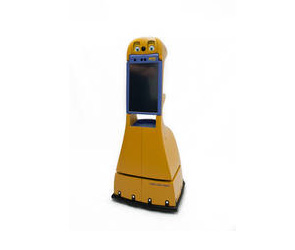
CompanionAble
-
Size:- footprint 0,45m * 0,5m
- height 1,2m
- weight 40kg
- differential drive
- 2 driven wheels
- 1 castor wheel
- frontal camera SVS-VISTEC eco274CVGE (ethernet) with fisheye lens in “nose”
- MS Kinect sensor in display
- laser range finder SICK S300 frontal at height 0,23m
- sonar array Metralabs 14x transducer at height 0,1m
- AKG CMT microphone (3 directional + 1 omni-channel) on top of head
- bumper ring at bottom
- odometer
- processor Core i7-620 (2.66GHz)
- 8 GB RAM
- Linux openSUSE 11.3
- Ah Li-ion batteries
- 12h operating time
- rear docking connector
- 15,4” touch sensitive display
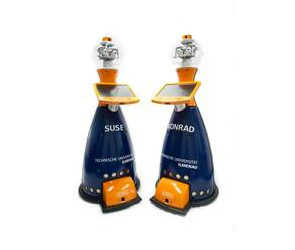
Konrad & Suse
-
Size:
- footprint 0,6m * 0,75m
- height 1,5m
- weight 75
- differential drive
- 2 driven wheels
- 1 castor wheel
- omnidirectional camera Metralabs 4x µEye122xLE-C (USB) rig on top of head
- frontal camera Imaging Source DFK21F04 (Firewire) in neck
- laser range finder SICK S300 frontal at height 0,4m
- sonar array Metralabs 24x Senscomp 600 transducer at height 0,1m
- AKG CMT microphone (3 directional + 1 omni-channel) on top of head
- bumper ring at bottom
- odometer
- RFID sensors on neck and floor
- acceleration indicator
- processor Core2 Duo T7400 (2.17GHz)
- 2 GB RAM
- Linux openSUSE 11.3
- 42 Ah lead-acid batteries
- 10h operating time
- 15” touch sensitive display
- Metralabs 5-DoF head
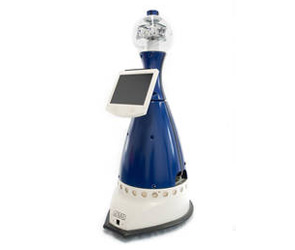
ALIAS
-
Size:
- footprint 0,6m * 0,75m
- height 1,5m
- weight 75kg
- differential drive
- 2 driven wheels
- 1 castor wheel
- omnidirectional camera Metralabs 4x µEye122xLE-C rig on top of head
- frontal camera SVGigE in neck
- laser range finder SICK S300 frontal at height 0,4m
- sonar array Metralabs 24x Senscomp 600 transducer at height 0,1m
- bumper ring at bottom
- odometer
- 1x processor Core2 Duo T7400 (2.16GHz)
- 2 GB RAM
- Linux Fedora 15
- 1x Apple Mac Mini (2.66 GHz)
- 4 GB RAM
- Windows 7
- 42 Ah lead-acid batteries
- 10h operating time
- 15” touch sensitive display (connected to Windows PC)
- Metralabs 4-DoF head
- Wii Game Console
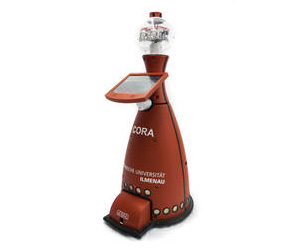
CORA
-
Size:
- footprint 0,6m * 0,75m
- height 1,5m
- weight 75kg
- differential drive
- 2 driven wheels
- 1 castor wheel
- omnidirectional camera Metralabs 4x µEye122xLE-C (USB) rig on top of head
- frontal camera Imaging Source DFK21F04 (Firewire) in neck
- laser range finder SICK S300 frontal at height 0,4m
- sonar array Metralabs 24x Senscomp 600 transducer at height 0,1m
- bumper ring at bottom
- odometer
- processor Core2 Duo T7400 (2.17GHz)
- 2 GB RAM
- Linux Fedora 12
- 42 Ah lead-acid batteries
- 10h operating time
- 15” touch sensitive display
- Metralabs 5-DoF head
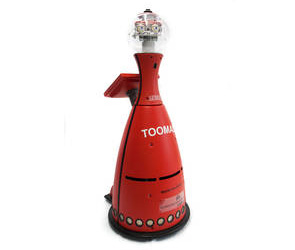
TOOMAS
-
Size:
- footprint 0,6m * 0,75m
- height 1,5m
- weight 75kg
- differential drive
- 2 driven wheels
- 1 castor wheel
- omnidirectional camera Sony RPU-C2512 on top of head
- frontal camera Imaging Source DFK21F04 in neck
- laser range finder SICK LMS200 frontal at height 0,4m
- sonar array Metralabs 24x Senscomp 600 transducer at height 0,1m
- bumper ring at bottom
- odometer
- processor Core2 Duo T7400 (2.17GHz)
- 2 GB RAM
- Linux Fedora 12
- 42 Ah lead-acid batteries
- 10h operating time
- 15” touch sensitive display
- Metralabs 5-DoF head
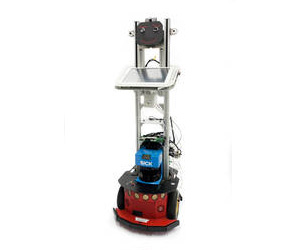
HOROS
-
Size:
- footprint 0,43m * 0,52m
- height 1,25m
- weight 20kg
- differential drive
- 2 driven wheels
- 1 castor wheel
- frontal camera (forehead) Webcam
- frontal camera (eye) FireWire Firefly
- laser range finder SICK S300 frontal at height 0,32m
- sonar array at height 0,185m
- bumper ring at bottom
- odometer
- Processor Intel® Core 2 Duo P9600
- RAM DDR3-1066 SO-DIMM 2GB
- HDD Samsung HM250HI 2,5'', SATA, 250 GB
- Linux openSuse 11.3
- Slimbook P120, processor Intel Centrino 1,5GHz
- 1 GB DDR RAM
- 40GB Festplatte
- Windows XP
- 42 Ah lead-acid batteries
- 10h operating time
- 1h operating time
- Metralabs 5-DoF head
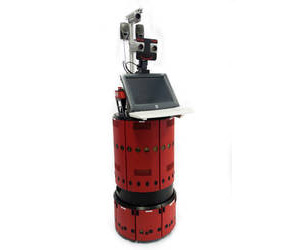
PERSES
-
Size:
- footprint 0,53 m in diameter
- height 1,8m
- weight 150 kg with current setup
- synchronous drive
- 4 driven wheels
- 48 sonar sensors (aligned in two layers)
- 24 infrared sensors, 56 tactile sensors (bumpers)
- laser range finder SICK LMS400
- 3 color cameras (Sony DFW-VL500):
- 1 omnidirectional color camera with 360° panoramic view at the top of the robot
- 2 frontally aligned (binocular) cameras on a 6 DoF active-vision head
- processor Core i7-620M (2,6 GHz)
- 4 GB RAM
- Linux openSUSE 11.4
- 60 Ah lead-acid batteries
- 6h operating time
- 15” touch sensitive display
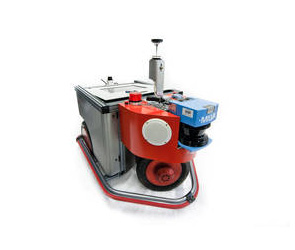
MILVA
-
Size:
- footprint 1,05 * 0,70m
- height 0,6m
- weight 120kg
- tricycle drive
- driven and steered front wheel
- omnidirectional camera RDFW-VL500 at height 0,90m
- laser range finder SICK PLS 200 frontal at height 0,52m
- laser range finder backward Hokuyo URG-04LX at height 0,63m
- 4 backward sonar sensors at height 0,24m
- bumper ring at bottom
- odometer in both rear wheels
- GPS-module
- Mini ITX Mainboard “Thunderbird/MM”, Fa. Lippert Automation
- processor Pentium M Centrino 2 GHz
- 1 GB RAM 333 (PC2700)
- Linux openSUSE 11.2
- HDD 2,5” Hitachi HTS 548040M94T00 40 GB
- 24V (2 x 12V) 65 Ah Panasonic lead-acid batteries (LC-X1265P)
- 6h operating time
- WLAN-module
- 15” display Optrex with touch screen add-on “eTurboTouch 15” (capacitive)
- joystick
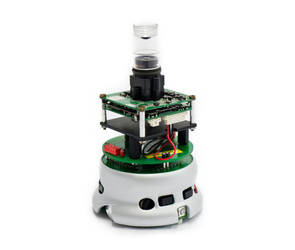
Khepera
-
Size:
- diameter 70mm
- height 30mm
- weight 80g
- differential drive
- 2 driven wheels
- 2 castor points, 0,02 . . 0,5 m/s
- 8 infra-red (range 100mm)
- 3 analog inputs (0-4.3V, 8bit)
- communication standard serial port, up to 115kbps
- incremental encoders (roughly 12 pulses per mm of robot motion)
- front camera
- omni-directional camera (analog)
- Motorola 68331, 25MHz
- RAM 512 Kbyte, Flash 512 Kbytes (Programmable via serial port)
- (Khepera I: Motorola 68331 CPu, 16 MHz, 256 KB RAM, 512 KB EEPROM)
- NiMh-Accu
- max. 1h operating time
- serial port for power supply and communication for higher level applications
- remote control software for Labview, Matlab and Sysquake