EXPO21XX e-Fair  Navigation : EXPO21XX.com Home > FAIR21XX > e-Hall > King Mongkut's University of Technology Thonburi

 
Home Register your company About usContact us
Home back to hall map back to hall   
Go to Search Go to Search
  E  

11
E11    Thailand King Mongkut's University of Technology Thonburi
Show Room
 
Projects
Variable-Damper Knee Prosthesis
Introduction
Today, there are more than 50,000 people with disabled legs in Thailand. The causes are car accident, bomb, diabetic neuropathies, and congenital abnormality respectively. These disabled individuals want to have prosthetic legs that are fitted, agile, durable and light weight like normal human legs. These kinds of prosthetic legs are at present manufactured in western countries which are very expensive for people in developing countries.

Our Target
We focus on using the prosthetic technology in designing artificial devices as a substitution for the lost legs. Every disabled individuals have right to live his/her normal life. Technology must be used to fully substitute the ambulatory function of the real body parts. Classical prosthetic devices still need assistance from the helper. Therefore, a modern prosthetic knee has been developed at FIBO to assist orthopedically impaired to live and function comfortably.

Methodology
In reality, the properties of human muscles consist of mass, spring and damper. However, most of current prosthetic knees are only made of mass and spring affecting pace and mobility. Consequently, we have added a variable damper that could be adjusted by amputees through a microprocessor controller. We believe that our artificial knee will lead to the improvement of life for disabled persons.

Expectation
The knowledge of designing and manufacturing our variable-damper knee prosthesis shall be transferred to agencies responsible for providing knee prosthesis to ones in need.

 
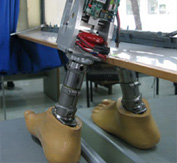
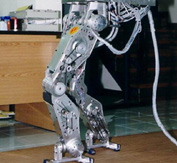
FIBO's variable-damper knee prosthesis
 
Analysis and Design of Anthropomorphic Robot Hand
Introduction
Anthropomorphic Robot Hand proposes analysis and mechanical design of a robot hand that resembles physiological structure and motion of the human's hand. Human hands have advantages of high dexterity and flexible grasping capability. The robot hand that bears similar advantages could be applied to variety of hazardous manufacturing processes to reduce risk for workers or can function as a prosthetic hand for handicapped people.

Problems
In general, hands assembled in the robotics industry are grippers and the like. They can only perform basic functions such as stretching and compressing to catch objects. It could be used with objects having simple shapes. Therefore, there is the need to develop a new robot hand that consists of several degrees of freedom for practical application in our daily lives. Our FIBO hand is designed to resemble the human hand to increase ability of grasping more complex objects under normal performance.

Methodology
The anthropomorphic robotic hand consists of five fingers. Each of them has three degrees of freedom (DOF), leading to 15 DOFs totally. It is 5 DOFs less than a human hand. The size of this hand is 1.5 times larger than the human's. They are all driven by servo motors. The transmission system is composed of gears, timing belts, and pulleys.

Expectation
This prototype of robot hand must operate and function closely to human hand in grasping various shaped objects at performance better than industrial robot's grippers.
 
FIBO 's Anthropomorphic Robot Hand
 
Haptic Interface with Virtual Reality
Virtual reality (VR) systems are techniques that allow people to experience an imaginary or unreal world without actually building it. The ordinary VR systems allow people to think that they are in the unreal world constructed by computer graphics but they cannot interact with it. The VR system equipped with the haptic rendering ability is a new concept. It allows users not only to see the virtual environment but also to interact with it.

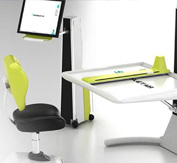
The Haptic Force/Moment Display for Virtual Reality is composed of force/moment interface for displaying realistic sensation and visual interface for displaying virtual scene. In this system, the users will see the virtual objects through an LCD planar display or a Head-Mount Display, and they will feel like they are actually manipulating the real objects by holding the robot end effector (See image below).

Haptic Force/Moment Interface. The system consists of a six-degree-of-freedom robot, a robot controller, a six-degree-of-freedom force/moment sensor and a high performance computer for physically based simulation. The robot will render the realistic feeling to the users by:
  1. The force sensor will measure forces and moments exerted by users at the robot end effector.
  2. From the force/moment information, the system will calculate appropriate motions that satisfy the virtual object models and sent them to the robot controller.

Visual Interface system consists of a CCD camera, a LCD planar display and a computer for creating and displaying a virtual screen. By CCD camera at the LCD planar rear, the system will capture the picture composed of user hands and the device (the robot end effector). This picture will be used for estimating the device position and orientation. The computer graphic will used this device position and orientation to create an appropriate virtual object pose. Because the user hands is still on the screen of LCD display with the virtual objects overlaid on the robot end effector, the users will feel like they see their hands grasping the virtual object through the LCD display.

For example, to simulate the virtual cubic box in free space, the users will see the virtual cubic box, created by a computer graphic, through the LCD planar display. Concurrently the users will feel the inertial of the cubic box by holding the device at the robot end effector. Forces/Torques exerted by the users will be measured. The force/torque information will be used to calculate the appropriate motions that satisfy the cubic box physical model. These calculated motions will be sent as the position commands to the robot controller. If the cubic box is 1 kg mass and the applied force is 1 N, the robot will move the device at the acceleration of 1 m/s2.

The objectives of this research are to build a prototype of haptic force/moment display for virtual reality system and to improve the ability to display the realistic sensation to the user.

 
An overview of a haptic testbed, designed and built at FIBO
 
Security Robot
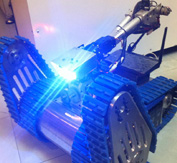
At present, robotics technology has advanced into our daily lives and has been applied in several applications. Robots are currently used in factories to assist human being in tasks that are characterized as meticulous, monotonous, time consuming and dangerous. Center of operation for Field Robotics Development (FIBO) realizes the importance of using robotics machines in dangerous activities e.g. hazard area investigation, bomb and poison gas investigation and removal. The unfortunate event at the Pantip Plaza Shopping Mall resulted in severely injured policeman while trying to deactivate a bomb. Such an event has motivated and prompted FIBO to take leadership in designing and fabricating a prototype of security robot for Thai police department. In addition, this project will promote educational and research activities in robotics as well as build critical mass of technologists who are able to generically use robotics and automation technology to enhance productivity in local industry

This project benefits from our previous research work in MOBO 2.0: An Omni-directional Wheeled Mobile Robot. MOBO was built by FIBO in order to understand mobility of a mobile robot, using 45 degrees omni-directional wheels. MOBO can be manipulated in any direction. However, the security robot has to be redesigned to be more compact to operate in a limited and highly constrained area. A wireless CCTV and a remote operation system have to be integrated into this security robot to feed back visual information to the operator and allow the operator to plan the robot's motion before physically invading dangerous zones.

In this project, we focus in designing and integrating of standard, industrial graded equipment and components. Such practice will yield higher performance of the overall system. The three major parts are body, wireless CCTV and Remote operation control. This prototype of security robots is being sponsored by the Foundation of Research in Information Technology (FRIT.). It will work shoulder to shoulder with the Thai police in investigating and removing bombs in public areas. It will boldly go where no man has gone before.
 
 
Serpentine Robot
Many kinds of animal motions have mysterious characteristics. One example is the serpentine motion, a motion made by eels, lampreys, rattlesnakes and garter snakes that looks like sinusoidal or S-curve. These animals can propel their bodies by muscular forces. In this research, we are interested in the snake motion, which is suitable for moving over various types of terrain. The serpentine motion is useful in exploring task, especially in complicated and hazardous areas i.e., nuclear power plants, piping inspection platform and various manufacturing systems as well as some applications in aerospace.
 
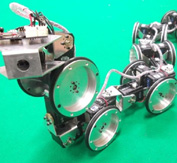
SR-1: The first prototype of serpentine robot

The idea of having a nuclear plant in Thailand has prompted the Center of Operation for FIeld RoBOtics Development (FIBO) at King Mongkut's University of Technology Thonburi (KMUTT) to design and build a multi-joint robot, SR-1. This prototype is now extended to study the serpentine motion, based on the Active Cord Mechanism theory initialed by Shigeo Hirose at Tokyo Institute of Technology, Japan.

At present, we have implemented this theory in our 2nd generation seven revolute D.O.F SR-1, which can move forward in multiple directions with different torques provided by actuators in serpentine patterns. It has many passive wheels attached to the body. Passive means there is no actuator on each wheel. The robot motion is constrained by each wheel, allowing motion in the tangential direction. The different torque can generate forces acting on its body. When these forces overcome the tangential friction, they will propel SR-1 to move in forward or backward directions.

We will integrate an artificial intelligent algorithm (AI) such as the potential function method into the generalized motion planning and other methods for increasing the obstacle avoidance capability of our serpentine robot. FIBO extremely appreciates the financial support from the Thai-Toray Foundation. It is expected that the outcome of this research will lead to the discovery of a control methodology in maneuvering this type of robot in highly constrained environment. The byproduct is a robot prototype, which will be used as a test bed for further studies.

Force acting on links of the Serpentine robot

During our experimentations with SR-1, we found some critical properties and improper structures which made uncertain movements. Such as, over length of links uncertain wheel contacts, and twist and bending of each links because of material strength and old designing. All these troubles led caused SR-1 to stagger uncontrollable in many directions. Serpentine robot SR-2 was designed to eliminate all these problems in SR-1. The rolling angles of each wheel profile the ground and the shorter length of links make continuous propelling forces. Our SR-2 has twenty serial revolute joints. Each link is 140 mm. A link weighs 1051g. A motor weighs 541g. Every joint controls velocity serving level. This project is financed by the National Research Council of Thailand [NRCT].
 
Image Guided Motion of a Humanoid Robot
R&D robotics mainly focuses fixed robots to promote higher productivity in manufacturing industry. However, there are several types of task that are not suitable for fixed robots. Mobile robots, having mobility performance, are currently being studied and researched by many leading academic institutions around the World e.g. M.I.T., Harvard, Stanford and Waseda University. In addition, Honda, one of the largest automobile manufacturers, has been spending more than billion yens in developing a series of two-legged humanoid robots. Legged robots have greater advantage and dexterity, compared to wheeled robots when rough terrain exploration is required.

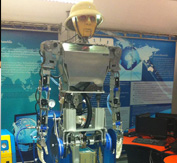
The center of operation for FIeld roBOtic development (FIBO) at King Mongkut's University of Technology Thonburi realizes the significance and impact of new technology associated with the development of a humanoid robot. Examples of such technology are real-time three dimensional balancing of dynamically unstable system, vision system and artificial intelligence. The analytical part of this research will be devoted to the extension of Kane's dynamics theory, ZMP, Gravity Reaction Force and Conservation of Energy. The stability of walking motion will be enhanced through the use of visual information. In addition, we will design a novel, omni-directional leg mechanisms, which will be installed in our humanoid prototypes.

Our research plan is defined as follows:
  1. Study the theory of Biomechanics to determine an optimum design of a humanoid robot prototype.
  2. Research on mobility and dexterity of the humanoid robot prototype.
  3. Design a control system: passive real time and active real time of D.C. servo motors.
  4. Integrate vision system into the robot to determine advanced postures and trajectories of the robot by using an artificial intelligence theory.

We are currently investigating the robot's kinematic and dynamic models. The images below depict our initial concept related to a lumped mass representation. Our humanoid robot is considered the first prototype of its kind in Thailand. FIBO is committed to initiating and disseminating new technology for higher productivity. The outcome of this research will again prove that high performance automation systems could be achieved by thoroughly understanding the fundamental knowledge.

 
Model of a two-legged walking robot using a lumped mass representation
 
Sign Language Recognition System using Hidden Markov Model
Sign language is exchanging information for most of the hearing impaired. In addition, it also supports the communication between the deaf and normal person. This research proposes Thai sign language recognition system using Hidden Markov Model for transcribing human sign language into text or speech. The below illustrates words of "You" and "We" in Thai sign language.

Example of Thai sign language.

As shown in the image below, this system measures hand gestures using input devices which are CyberGlove and Motion tracker on each hand. All training data such as finger flexures and hand position/orientation are captured by using CyberGloves and Motion tracker, respectively. Those data inputs are then preprocessed and classified into 4 categories which are posture, position, orientation, and motion. This preprocessing section solves the problem of determining end points in a sequence of gesture input and detecting discontinuities for segmentation. This section also determines whether the hand movement is represented by one or two-hand gesture. After preprocessing section, those data inputs are then compressed by the vector quantization section. This greatly increases the speed of training and recognition processes of Hidden Markov Models. In continuous Thai sign language recognition, natural language processing is used to choose the most probable word sequences, which have each word affects the probabilities of its subsequent word occurrences, from all trained word sequences.
Consequently, a user can communicate with the other person by using this trained Thai sign language recognition system. The output of this system could be text or synthesized speech.
 
Thai sign language recognition system
 
Automatic Adjusting Device for Thai Musical Instrument
Thai music is one of the most significant heritages of the royal Thai Kingdom. Inherited from our ancestor for more than a thousand years, the music reveals special uniqueness and identity. FIBO realizes its responsibility to perform R&D and invent technology to maintain this national heritage. Her Royal Highness Princes Sirinthorn graciously led a team to study and establish a standard of frequencies of Thai musical instrument. Such standard enormously yielded benefits to the Thai musical community in maintaining 'exact' sound of their instrument.

Our particular interest is an inability to detect and measure frequencies of Thai traditional xylophones. Current techniques could not be use since the sound waves of xylophones occur within very short time (£ 30 ms.). In addition, the wave is quite fluctuated and coupled with noises, especially at very low and high frequencies. Available frequency adjusting devices for western musical instruments are unable to deal with such noises.

We implement the 'Zoom Analysis' method to determine the frequencies of music. This method is suitable to measure incidental wave-signals at high frequencies. The frequencies are intentionally reduced for ease in signal period finding. This is analogous to the way we amplify, to search for details, in images. The resulting measured frequencies will be then compared with standard values. This new adjusting device promotes the convenience among Thai musical artists. We highly appreciate the research funding from the Foundation for Research in Information Technology (FRIT).
 
Graphic User Interface & Research Platform at FIBO
 
Crop Collecter Robot
Due to recent growing competitiveness among industries worldwide, one strategy for gaining competitive advantage in the world markets is by using technological capabilities in supporting industries especially in designing and developing robotics and automation system. Unfortunately this state-of-the-art technology has not been well developed as supposed to be in Thailand. Most local industries rely heavily on "overpriced" foreign technology. Such technology also requires high maintaining cost, leading to an unnecessarily high manufacturing cost. Thus, the so-called 'technology of our own' will play an important role in Thai industrial development.

Realizing such a critical problem, Center of Operation for Field Robotics Development (FIBO) at King Mongkut's University of Technology Thonburi, in collaboration with Siam Yamato Steel Corp has started a project to design and develop an automated robot for heavy industry. This robot is designed to handle large payload and harsh environment. Its main function is to collect large steel crop, weighed up to 300 kg, 500-2000 mm length at 900 degrees temperature. The total cycle time has to be less than 50 sec, in which less than 10 sec is allowed to be on the operation line. The use of this robot will reduce the amount of time used in bar cutting operation, promoting overall productivity of the factory by large factor.

This collaboration between FIBO and Siam Yamato Steel Corp will open up a new horizon of university's commitment toward Thai industries for less dependence on imported technology. Furthermore, this is a chance that all of us can learn and become technological self-sufficient like our foreign counterparts. We at FIBO believe that, given enough support from the government and understanding from private sector, Thai industries are able to compete in the new world economy.
 
FIBO Godzilla (Crop Collector Robot)   &   FIBO Godzilla with its body
 
Ribbed Smoked Sheet Punching Machine
Natural rubber industry is one of the most important industries in Thailand. Its revenue is about 82,000 million baht a year. Ninety percent of all rubber produced in Thailand is exported, and about 80 percent of the rubber is in the form of ribbed smoked sheets (RSS). Ribbed smoked sheet manufacturers suffer quality problem due to impurities settling in the rubber during manufacturing process

To yield good quality products within a reasonable short time, the method of removing the impurities mentioned required highly skilled labor. The highly skilled labor can only be obtained after many months of training and practicing and longer continuous operation. It is beneficial to the industry to have a machine capable of removing impurities in rubber sheets to substitute the skilled labor, because the machine can provide more consistent product quality, longer continuous operation, higher productivity, and better quality of life of the workers.

This project is aimed to develop a punching machine capable of removing the impurities in ribbed smoked sheets for benefits to the industry. This machine consists of two major systems: an impurity detection and an impurity elimination systems.

These two systems work correspondingly and employ computer control. The scope of function of this machine is from loading rubber sheet by a worker, inspecting the sheet to pinpoint impurities, and then cutting out the portions of rubber sheet containing impurities. These tasks are done automatically. Workers only load and unload the rubber sheets.
 
The inspection and impurity removing task by highly skilled labor &  the ribbed smoked sheet punching machine
 
Assembly Jigs and Automatic Multi Spot Welding Guns
Industrial demands on robotics and automations have sharply increased. However, most local industries rely heavily on 'overpriced' foreign technology. Such imported technology also requires high maintaining cost, leading to unnecessarily high manufacturing costs. Thus, the so-called 'home grown technology' will play an important role in boosting Thai industrial productivity.

Realizing our principle, namely, 'We don't design problems. Problems design FIBO', the institute of FIeld RoBOtics (FIBO) at King Mongkut's University of Technology Thonburi, in collaboration with the Summit Auto Body Industry Co. Ltd. (SAB), has launched an engineering project of designing and developing an automatic spot welding system for automotive industry. This system includes eight assembly jigs and two automatic spot welding guns. All components operate autonomously under a pneumatic control system. An operator only inserts automotive parts on this system and push a start button. The system automatically works towards the final state of welding parts.

First, we designed and installed an assembly jigs for automatic multi spot welding guns. Second, we constructed two multi spot welding guns. Each system has two or seven spot guns. After our installation in early March 2002, our systems are still working properly and effectively in the production line of Isuzu D-Max model.

This project has exhibited the valuable collaboration between FIBO and automotive industry. SAB's professional engineers educated FIBO staffs on how to design the best jigs. FIBO incorporated the knowledge of computer
control to the system designed. We both promote 'technological sufficiency', equivalent to our foreign counterparts. FIBO wholeheartedly believes that, given enough support from the Thai government and understanding from private sector, Thai industries are able to compete in the new world economy.
 
Assembly Jigs  &  Spot Welding Guns
 
Development of reading tools and programming for various TOU meters
Recently, regional electricity demands are highly increasing and continuously expanding in every sector of the Kingdom of Thailand. As a result, regional consumers have different profiles in electrical demand. The Provincial Electricity Authority [PEA] has changed a method of charging rate from TOD (Time of Day) to TOU (Time of Use). Accordingly, the collecting processes: such as recording and adjusting factors of charging rate is indeed too difficult to get carried out. In addition, the new types of electric meters have been changed for solving this inefficiency and making it easy to process. Infrared recording meter is also used to reduce this burden. Electric rates are read by infrared recording heads, from electric meter to computer as shown in Figure 1. Amount of electric usage data is transmitted via serial communicating line and calculated for billing.

At present, the different types of electric meters are one of the biggest problems. The specifications in each product are different and incompatible to each other. A recording operator needs to carry all types of infrared reading recorders to measure which is cumbersome. Insufficient equipment using in this work also leads to time delay and human error.

To solve this problem, Institute of FIeld RoBOtics [FIBO] at King Mongkut's University of Technology Thonburi [KMUTT] and PEA are collaborating towards a new development of infrared recording heads that can transmit all data formats in various types of electrical meters, as shown on the left side in the image below. This breakthrough of reading equipments is an example of national independent from foreign technology. With appropriate stimulating fund from the government and related agencies our recording device will perhaps appear in the world market.
 
Recent reading format from TOU meter  &  Development reading format from TOU meter
 
Vertical Moving Robot (V-Move)
"V-Move" has 2 majors Crane and Robot Platform. Crane is installed on the top of building to support the weight and to control the vertical and horizontal movement of the robot. The whole system of 'V-Move' is show on the left side in the image below.

The mechanism of robot platform can be explained as follows. The driving system comprises of 2 sets of wheels (4 wheels/set). The first set is the driver wheel that allows the robot to move horizontally on the building surface. The second set, without motor, provides support when the robot moves in vertical direction. The robot can change direction from horizontal to vertical by switching between two sets of wheels using the pneumatic cylinder.

The hole-down mechanism comprises of 4 suction cups attached directly to 4 pneumatic cylinders. This mechanism is used for holding the robot in stable position the vertical plane of the building. It causes the robot not to slip forced by wind or other forces.

Translation in the vertical plane requires the perpendicular force to create the vertical friction force. Hence, a blower is designed to generate sufficient perpendicular force on the robot to keep it attach perfectly to the plane.

From the preliminary experiment at the 'FIBO' building, the blower can make sufficient perpendicular force such that 'V- Move' robot can move smoothly in the vertical and horizontal plane with the velocity of 0.3 m/s.
 
The simulation of Vertical moving Robot (V-Move)  &  Real Vertical moving Robot (V-Move)
 
A Gaussian PID Controller
When FIBO first stepped into the microelectronic industry, one of its problem was to tackle the high precision hard disks of the ReadRite plant. Instead of working on hardware improvement, we decided focus our effort in the process control algorithm. A magnetic slider head is consisted of read-write magnetic coils and compound material of wafer substrates. Recording heads are quite miniature components (about 1 mm2) that read and write information to and from hard-drive or another medium. Figure 1 shows a magnetic slider head attached on a metal suspension. Slider head will hover above disk media surface about 2-5 in (micro-inch) at speed of 7500-10000 rpm while reading or recording data.

Our attempt is to control the standard deviation (s) of strip height toward the final resistance target. To read this value, we use the measurement of Magneto Resistance Recording (MRR). However, the relationship between resistance and strip height is not linear, but a hyperbolic relationship. Therefore, it is quite a challenging to control the strip height in the micro-inch level, in responding to very sensitive MRR. Without proper control algorithm at the lapping process, high quality hard-disk heads could not be produced.

Our FIBO research team has studied on lapping machine called MMX as shown in Figure 2. Visual C++ program is used for interface and control. The lapping procedure has many parameters that effects product quality such as, lap plate speed, X-Y lapping motion and multiple lapping forces. Lapping must also be done with diamond slurry. A bar contains over 35 sliders, whereas overall standard deviation of lapped heads is under controlled by multi lapping forces. The great result of our effort is the reduction of sigma (s) from over 3.0 to 1.2. Ohm.

We implemented PID control: a fundamental control theory. Some special techniques, such as neural filtering used to guide feasible MRR resistance in each lap step and separated multi-lapping forces by the Gaussian distribution technique are employed. In addition, we tuned and optimized all parameters to reduce the high sensitivity at final lapping target. After our success in the micro inch level, FIBO in collaboration with ReadRite is in a process of entering new challenges namely very precise procedures called High Density PICO: HDP, and FEMTO. The terms PICO and FEMTO stand for precision.
 
A slider bonded on a stainless-steel suspension  &  the lapping machine, MMX
 
Air duct cleaning robot
Bangkok today has many high-rises with central air conditioning systems. An air conditioning system, in general, uses rectangular cross section air duct that is very difficult for inner access. Cleaning of the enclosed duct is rare and leading to dust inside the duct. This dangerous dust is undoubtedly harmful to the people in the building. Manually cleaning process using human is not only harmful due to inhalation of dangerous dust but also the orientation of the duct in a high rise is impossible for human to be inside the duct system.

The solution we came up with is to send small remote controlled wheel mobile robots inside the duct system to help us clean the mess. The picture of the robot is as shown in the figures and in the video. The robot system is composed of the locomotion system and the manipulation (cleaning) mechanism. The locomotion system has two 24 V DC motors connected to gear trains to generate torque to propel the robot. The cleaning mechanism utilizes power from 12 V DC motors to expand or contract the cleaning mechanism in all direction according to duct dimension. The motors are also used to spin cleaning brushes at high speed. The cleaning mechanism has a modular construction (with ball spring plunger lock) for easy clean up after use or routine maintenance. The robot also has a CCD infrared camera to help the user navigate through the duct system.

Our future plan is to incorporate the cleaning agent nozzle system or disinfectant system for the version that will be used inside the restaurant, infirmary, or other hygienic places.
 
Fish Robot (Analysis And Mathematical Modeling of Thunniform Motion)
Currently, the phenomenon of fluid flow for fish and aquatic animals swimming is unknown. Fish and aquatic mammals propel themselves differently from human. Understanding their propulsion systems could provide us a new technology.

This research, Institute of Field Robot (FIBO) uses the yellow-fin prototype tuna to build the robot because of its movement ability at high speed for longer period, tuna-form mode, which make us believe that its movement will be the most efficient locomotion mode than other aquatic mammals. Additionally, the body profile is both symmetrical in horizontal and vertical plane, which is helpful for finding out the equation of motion.

The objective is to study the relative of movement and energy in the swimming mode, including mechanism of fluid flow around the fish body. Expect that the new aquatic vehicle propulsion will be developed by mean of this study to be more practical. Moreover, this yellow-fin tuna robot is also used for experimental equipment.

For this study, it would be divided to 4 parts:
  1. Design and construction
  2. Measurement installation
  3. Mathematical modeling and control system design
  4. Experimentation and conclusion.

This research studies the physiology of the yellow-fin tuna to design mechanism for the construction a fish robot and subsystem installation in the future.

 
Fish robot prototype  &  New fish robot prototype
 
Helibot
Up to now, various researches about UAV have been made using knowledge of various areas. A widely interested area is the automatic control. The object of this research is to develop an stabilization augmented control of helicopter based on the concept of mechanical energy. The developed controller is expressed in the form of Rayleigh's energy dissipation with automatic adjustment in accordance to each conditions of the system. However, the difficulty in controlling helicopters lies in highly nonlinear dynamics, strongly couple and relate between variations which are present in the model.

This research shows the effective use of physical properties of the controller, and shows how the stability of mechanical system depends on the derivative gain (Kd), mechanical power, i.e. the time derivative of energy considered in the design of controller.

In this research, the mechanical power of the system was considered in the design of stability augmented controller for helicopter to maintain hovering flight. The function of power vector of the system was divided into 2 parts. The first one is the internal power vector which is produced by internal forces, i.e. the power of the system. The second part is the external power vector which is produced by external forces. This part is the result of control forces, and is called “Artificial Power Vector”. In this work, the stability of the helicopter was considered since the sum and condition in all axes are zero. The artificial power vector was considered separately in each axis, because the property of the vector would be used to represent the stability. In addition, the resulted artificial power vector must not stall the helicopter.
 
FIBO Helibot
 
Small sized biped experimental testbed
Introduction
The project studies the dynamically stable smooth terrain walking. Low-cost and small sized biped mechanism is built to facilitate the experiment and learning process of bipedal locomotion. The knowledge acquired from this experiment will be transferred to the FIBO's Humanoid.

Design
The design focuses primarily on power to weight ratio of a motor and other critical issues in achieving dynamically stable legged locomotion. The result is a 50 centimeters high biped mechanism that weighs about 2000 grams and possesses 14 degrees of freedom. The biped mechanism's structure is made from Nylon plastic and Aluminum alloy (Al5083). The motor is an off-the-shelf R/C (radio control type, HITEC HS5945MG) servomotor. The biped has two types of sensor- 16 pressure sensors at the foot and a three axes gyro sensor at the hip. A charged couple device (CCD) camera will also be included to corporate the visual information in a navigation system in the future.

Computing Power
The biped is operated via remote-brain concept, i.e., computing power and the power source are off-board. It is powered by 1.2 GHz Pentium III processor. The computer is embedded in the National Instrument PXI (PCI extension for instrumentation bus) module and is used to control several I/O cards. The diagram of the system hardware is shown in figure 3. The embedded controller runs LabVIEW RT operating system. The software to control the biped is written in LabVIEW graphical programming language.

Algorithms
Pole and cart problem starts all curiosities. A fuzzy control scheme was used to control the simple single inverted pendulum. In the current biped mechanism, we plan to implement the neuro-fuzzy control scheme to achieve the most efficient gait. Separate model control scheme such as the impedance control, state feedback control, or nonlinear control methods will also be explored concurrently.
 
FIBO's small sized biped mechanism- skeleton diagram and the actual mechanism
 
Rubber Loading Robot
For the highly and continually demanding on utilized primary rubber material in order to be used and reproduced in the near future, such a broadening in the fields of automotive industrials and basis consuming products until to medical equipments, consequently, the top managing team had aimed to the extremely important of applying high level technologies in this industrial field such as robotics and automation technologies.

By the selected solution to the home-based technology, such company located in the south of thailand, a leader in a rubber producing company, had aimed contacted directly to FIBO ( Institute of Field robotics) at King Mongkut's University of Technology Thonburi (KMUTT), for helping to solve their struggles and bring its true. In realistic remaining, the problem designs us, as our principle namely 'We don't design problems. Problems design FIBO'.

Under mutual agreements, the project was launched in June, 2002 to set up a new firm name FIBO Corp co., ltd., for Robotics and Automation. This new conceptualized idea, called Unified thinking or Buranakarn thinking in Thai, is intended to strengthen engineering and technical companies in Thailand to reduce the loss of trained personnel from FIBO. However, in Thailand non-technical qualifications still ranks higher in networking and business opportunities. This company intends to bring more technical issues in Thai business and will play an important role in boosting Thai industrial productivity.

One problem of this project is the transporting or handling of raw materials during the production process. Robotic and automatic technology should be provided in the handling of rigid materials or products. Thus, the challenging thing is how to hold and move them from place to place within a specified cycle time.

The robot was built in transporting process from rubber tray to conveyor line. Previously, the worker had to carry heavy rubber bars 15 kg each by a hook and then put it on conveyor line to continue in process.

From observing and studying in human labor processes, we picked up an idea for holding the rubber using highly complicated rubber gripper to carry rubber out of the tray. The rubber flexibility, feeble shape and stickiness were solved by this gripper. This robot helps to reduce the heavy work load on humans and reduce incidents at work. (See gripper working below). The robot working area has about 4x10 m2 with highest-level about 2m.

We both promote 'technological sufficiency', equivalent to foreign counterparts. FIBO wholeheartedly believes that, given enough support from the Thai government and understanding from private sector, Thai industries are able to compete in the new world economy.


Torque Monitoring and Analysis for MINEBEA
Minebea (Thailand) Co., Ltd. is a world-class manufacturing company providing high precision electronics and mechanical components mainly for the computer markets. Recently, Minebea has been realizing that having data received from ball bearing inspection lines analyzed informs how well the ball bearing production process performs. Therefore, qualities of the product could be improved. However, investing in changing or modifying hardware would be very costly. Applying such a software analysis seems to be a better solution.

According to the inspection process, measuring torque from ball bearings in real-time could be done by using a measuring instrument. The data, then, is transferred to a wave comparator and displayed on the LCD screen. After approximately 5-10 minutes, the screen would bring up a new data and delete the old one. Hence, the only data that could be recalled is what is left in the memory of the wave comparator.

Institute of Field RoBOtics [FIBO] at King Mongkut's University of Technology Thonburi [KMUTT] and Minebea ( Thailand ) Co., Ltd. are collaborating towards a R&D development of monitoring and analyzing four torque quantities; max, min, average and peak-to-peak, received from the wave comparator. The result of applying statistical process analysis with the collected data would help Minebea see where in the production process the defection occurs.

The project is divided into two phases. Phase I consists of interfacing HIOKI 8731 wave comparator and managing data in real-time, and designing a network which would be able to handle 150 wave comparator while all data is collected at a central server. The project is currently up to the second phase where statistical software is created.

Beside beneficial information received directly from the torque analysis, the software could be used with other related products and processes. However, to receive an accurate result, adjusting database or raw data might be required.
 
A bearing pivot is measured  &  Recommended network
 
Articulated Arm Robot
According to the recent growing of Thai economies and industries, applying various types of strategies is very essential. Using technology is a very important key that potentially leverages Thai entrepreneurs up to the level that they could compete with others in the world market. Especially, industrial demands on robotics and automations in both designs and systems have been continuously increased. Relying on the overpriced foreign technology results in an unnecessarily high manufacturing cost. Also, this brings up the issue of a high maintaining cost.

Realizing these principles, the Institute of Field RoBOtics (FIBO) at King Mongkut's University of Technology Thonburi , in collaboration with the New Somthai Motor Work Co., Ltd., has launched an engineering project designing, developing and constructing an automotive part welding robot.

By applying theories and technologies in Articulated Arm and Iterative Newton-Euler Dynamic Formulation, the 6-DOF robot becomes available. Its main function is to handle loads up to six kilograms, with precision and repeatability of +/- 0.1

AC servo motors are used such that advantages of controlling positions, directions, and speeds are presented. Further, using harmonic gear yields a high gear ratio, powerful torque and minimum backrest that result in a high precision which could be used in other application, such as picking up.
 
Robot Simulation  &  Configuration of the designed robot
 
Emergency Medical Service system (EMSs)
The Emergency Medical Service system (EMSs) is a pre-hospital emergency care system, considering as a part of the national public health care plan that focuses on emergency cases, caused by accidents or acute diseases. And, patients in those cases become disabled. In order to provide them such an emergency medical service in time, new methods and technologies are introduced and tested in this very first state which hopefully would ease up procedures for field operators, increase effectiveness in working environments, and decrease pre-hospital operating times. For instance, Global Positioning System (GPS) and General Packet Radio Service (GPRS) are used to communicate between a project call center and ambulances so that the most accurate and effective direction could be given to operators.

To design and construct the system, the Institute of Field RoBOtics (FIBO), at the King Mongkut's University of Technology Thonburi , focuses its major attention into the following components:
  1. To provide pre-hospital health care services in time,
  2. To deliver patients to hospitals correctly with right methods,
  3. To provide first-aid to patients correctly,
  4. To speed up delivery time,
  5. To increase effectiveness of the emergency health care procedure, and
  6. To synchronize involvers into the same procedure.

In collaboration with the National Health Security Office, FIBO has been designing and developing components as shown below:

  1. Designing a workflow for a EMSs call center,
  2. Constructing a positioning system using mapping technologies,
  3. Constructing a vehicle tracking system,
  4. Using a web application to construct a customer relation management system, and
  5. Constructing a knowledge-based management to provide necessary information as requested.
 
 A designed call center system
 
Policy Research for Government Call Center
According to policies that the government gives opportunities for people to feedback problems in various channels, such as a direct contact to Office of the Permanent Secretary, Office of the Prime Minister, a postal document, a request through communication networks and etc., สปน directs the Institute of FIeld RoBOtics (FIBO) at the King Mongkut's University of Technology Thonburi to study and design a call center system applying modern technologies, for example, database system managements and technologies in call center, in order to eliminate recurrent issues and strengthen the system in such a way that problems could be efficiently solved more rapidly.

The objectives of the research project are to design the call center system in such a way that enhances the call center to be able to communicate and coordinate with Thai people in problems or issues they would like to discuss, and to design a managing system that networks all associated organization into the same workflow, according to each subject.

Hence, the major responsibilities that FIBO has to accomplish are researching technology, designing the system and workflow procedures, and creating a Term of Reference covering the following components:
  1. Designing the organization structure for the call center,
  2. Designing the workflow of the call center,
  3. Designing the system that connects to people in all possible communication channel
  4. Designing a security system for each component of the call center
  5. Designing the communication network connecting people to the associated organizations
  6. Designing a knowledge management system
  7. Designing a database management system using DBMS and data warehouse
  8. Designing an automatic time schedule planning system for employees
  9. Designing a call center overall evaluating system.
     
Communication channels of the call center   &  Links between the call center and the associated organization
 
A Complete Customer Protection System Project
The institute of Field roBOtics (FIBO) was introduced as a project advisor to assist the Office of the Consumer Protection Board (OCPB) in an internal resource survey project in order to improve the IT master plan, 2005-2008. It was the first project that FIBO and OCPB are in collaboration. After the project was successfully accomplished and FIBO outstanding performance was shined, OCPB, once again, appointed FIBO to work on another project as the project advisor. The objective of the project is to design and construct the complete customer protection system so that OCPB are equipped with an intelligent central database system. Indeed, OCPB would like the project to be beneficial as a one stop service system for Thai consumers, based on the most up-to-date creativity which would lead the system performance and administration to a perfection of E-Government system.

The project is aimed to enable the consumer to contact OCPB using web services, consisting of information providers, on-line complaint receivers, process attendants, PR representatives, and even information exchangers.

Due to the complexity of each component of the project, it is necessary to design and develop proper layouts for OCPB back office. Thus, in order to ease working environments, E-system will be introduced to automatically govern work flows. With an aid from an expert system which provides very accurate information conformed to the government standard, OCPB officers will work out a lot easier.
 
 
Competitiveness Enhancement Project in Fashioned Business
Project's Background
Thailand is one of the countries that produces and exportsa lot of fashion footwear products to foreign countries. Thai products are accepted by other countries because of their design, fashion, and great quality. However, the acceptance is still limited because Thailand missed on opportunities to enhance its image, increase price level and value.

With support from the Office of Bangkok Fashion City project, the Department of Industrial Promotion, the Institute of FIeld roBOtics (FIBO) and in cooperation with the Research and Design Service Center (REDEK) - King Mongkut's University of Technology Thonburi we have launched a Competitiveness Enhancement Project in Fashioned Business and Footwear Industry to develop and increase merchandise level in fashioned business to support the Thai footwear industry.

Objective
To develop and increase merchandise level in footwear industry by making and distributing under our own brand and strengthening manufacturers that already have their own brand. To increase footwear raw materials, accessories' values and fashion trend.

Procedure and Process

Project provides advising programs to support and strengthen competitiveness of manufacturers. There are 3 programs in this project which are:
 

Included in the project is a Center for Branding: CB (http://www.fibo.kmutt.ac.th/cb) to collect data, distribute news and management and decision making groups. The CB also collects lists of enterprises that relate to footwear industry, footwear raw material manufacturers, designers, importers, exporters, wholesalers, retailers, institutes, research centers, etc., to strengthen the fashion business. With that, the footwear industry and the raw material and accessories industries can compete in the international market.
Navigation
Exit to Hall
Company Info
Visit our Website
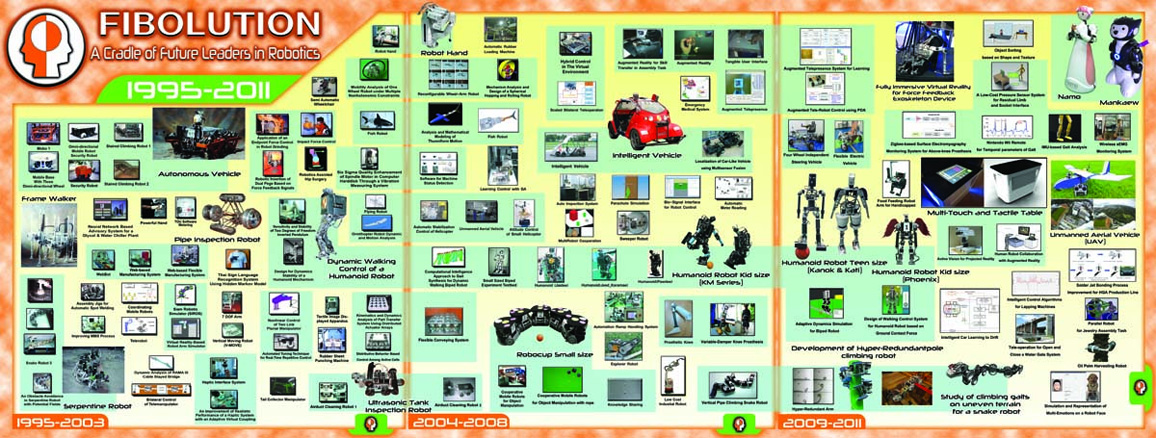
FIBO

History

The Center of Operation for FIeld RoBOtics Development (FIBO) was established during th 7th Educational Development Plan under the purpose of promoting higher education and advanced research in the area of manufacturing automation and industrial robots. This center also aims to render consultant service to Thai industries. The service includes technology selection and diversification, which will promote productivity and creativity of Thai industry.

At present, robots and mechatronic devices are extensively used in high precision manufacturing while maintaining minimum throughput time. Robots gradually evolved from simple mechanisms for moving some parts from one point to another point. Such ability allows us to accomplish only non-complicated tasks. In some countries having nuclear electricity generating plants some control instrument systems are developed and built to detect, measure and maintenance processes in hazardous environment. Robots are not only used in manufacturing but also used in space exploration. Examples of space robots are the Ambler, a Mar exploration robot, was built and developed at the Robotics Institute, Carnegie-Mellon University, JEM (Japan Experiment Module) project, a part of the “Freedom” space station, will be composed of many types of robots. These robots will perform several experimental tasks such as crystal synthesis and biological interaction. NASA also developed Viking Lander Robot, Lunar Vayer and RMS (Remote Manipulator for System) etc. During this period of economic turmoil in Thailand, FIBO will,however, focus on activities that are related to productivity enhancement. FIBO aims to design fabricate and test some robotic systems, pertinent to the needs from local industry. Therefor, the immediate objectives is to shorten technological gabs from developed countries as well as eliminate technological handicap among local factories. Realizing such an objective, FIBO is currently performing the following tasks:

  • Training new types of young engineers and scientists in the areas of robotics, CAD/CAM, manufacturing automation and mechatronics,
  • Designing, fabricating and testing protype of robots, CAD/CAM, automatic mechines and automation processes for local industry,
  • Selecting and reverse engineering automation technology that is suitable for Thai industry, - Carrying out reseach and development in robotics, manufacturing automation and CAD/CAM both in fundamental and applied areas,and
  • Taking partnership with multinational companies in automotive and electronics industry in assisting the setting up of their R&D units and operations in Thailand.

Philosophy

FIBO's Fundamental belief:

Respect and facilitate individuals, especially those who exhibit non-conventionally disruptive creativity, balancing personal excitement and societal success.

FIBO's Principle:

  • Effectiveness converts human intelligence, imagination and knowledge to tangible results.
     

FIBO's Management Policies and Missions:

  • Get the right things done right, although there is no support and/or whole ground against FIBO.
  • Value the failure and honor the successes. Every noble works is at first impossible and dry.
  • Do not economize and compromise on quality.
    Enable harmonious flow among comforts, achievement and dreams of all people involving within FIBO.


Code of conduct

RESPONSIBILITY FIBO - PUBLIC

  • We get the right things done right, although there is no support and/or the whole ground is against FIBO.
  • We do not economize and compromise on quality.
    We value the failures and honor the successes.
  • Every noble work is at first impossible and dry.
  • We concern for social responsibility, and put in our efforts and knowledge to contribute to society and communities.

RESPECT FIBO - FIBO

  • We enable harmonious fl ow among comforts, achievement and dreams of all people involving within FIBO.
  • We treat our colleagues, students and others with respect,dignity, fairness and courtesy.
    We provide a safe and productive working and learning environment for our people.
  • We perform our duties with honesty, integrity, impartiality and objectively.
     

RIGHTS FIBO - INDIVIDUAL

  • We try to balance work and private life.
    We invest in the ongoing enhancement of our skills and abilities.
  • We respect and facilitate individuals, especially those who exhibit non-conventionally disruptive creativity, balancing personal excitement and societal success.
  • We believe in the value of individual as FIBO owes its growth and prosperity to the contribution of everyone at FIBO.

13
  G  
Exit the Hall  Exit to Hall King Mongkut's University of Technology Thonburi   Exit to Hall   Next Corridor 6-10