|

13
 |
 |
| I13 |
|
 |
USA |
Fordham University, New
York |
|
 |
|
|
 |
 |
 |
 |
 |
|
|
|
| Navigation |
 |
|
 |
|
Offer Profile
The Fordham Robotics &
Computer Vision Lab, directed by Dr. Damian Lyons, was founded in the Summer
of 2002 . The Lab conducts research in Cognitive Robotics, in team
Wayfinding and Navigation and in agile robot platforms.
|
|
|
|
Research Abstract
|
Robotics
Navigation and Wayfinding in Robot teams
A team of robots is deployed to cooperatively generate a map of the area, an
area under reconnaissance or an urban disaster site, for example. The
objective is to generate an accurate map showing hazards, obstacles,
traversable routes, etc., very quickly and to communicate it back to a
command center. The map will then be used by a combination of human and
robot teams for effective operations in the mapped area.
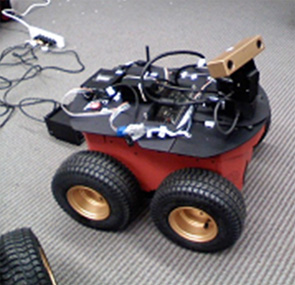
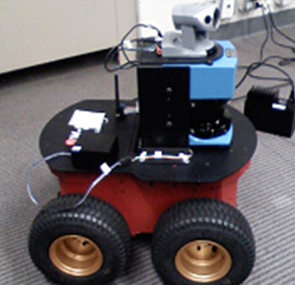
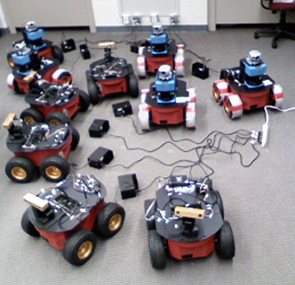
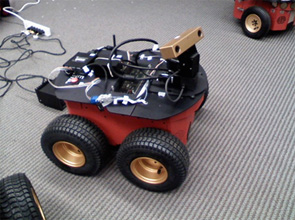
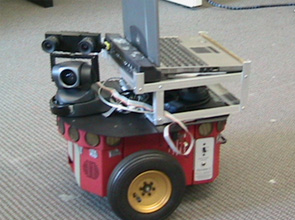
A team of 16 Pioneer AT3 robots is used as the base for these experiments.
Some robots are equipped with laser rangefinders, some with sterevision,
some with cameras an sonar. Although each robot carried an onboard computer,
the team communicates with an 88 core (11 HP DL160 G5 quad-core
dual-processors servers) cluster for performing landmark detection,
recognition, mapping , coordinate and reporting.
|
|
|
|
|
 |
|
 |
|
|
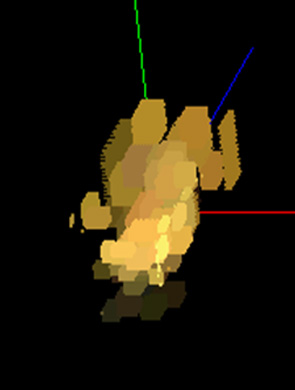
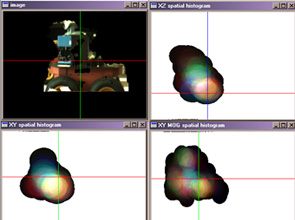
Terrain Spatiograms are a unique landmark
representation in which the image spatial information is replaced by terrain
spatial information. We havepresented experimental results for mutual
landmark recognition on two different model robots equipped with different
stereocameras, and with terrain spatiograms collected on one robot being
used on the other and more recently showed that because this representation
preserves depth structure, it is possible to identify and filter potential
occlusions.
|
|
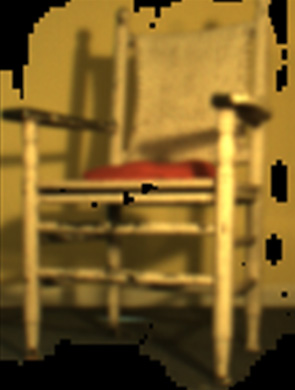
Image of Chair Landmark
|
 |
Disparity map
|
 |
Terrain Spatiogram
|
|
|
|
Agile, Legged Locomotion
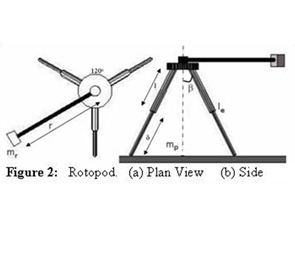
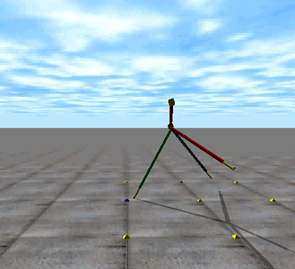
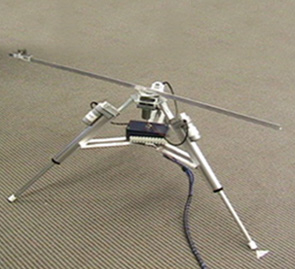
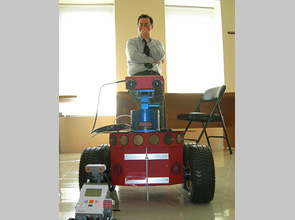
We have developed a novel tripedal design for energy-efficient legged
locomotion. The platform is called a rotopod, because its principle
mechanism of motion is rotation around leg endpoints.
|
|
|
|
|
|
|
What is it?
- The Rotopod is a novel robot mechanism which combines the features
of wheeled and legged locomotion in an unusual way.
- This robot has the advantage of legged locomotion in stepping its
1-DOF legs over objects, but its drive mechanism is a rotating reaction
mass that rotates the robot, in a controllable fashion, around each of
its legs, similar to a rotating wheel.
- The mechanism has the potential to transfer the energy from the
rotating reaction mass in an efficient manner to the legs, effecting a
spinning forward motion
How does a Rotopod Move?
- The Rotopod moves by rotating around each of its legs in turn.
- A rotation around a leg is call a step, and it results in the center
of the robot moving a distance
- A regular sequence of steps is called a gait.
- The robot can produce a broad set of gaits: stepping for various
values of q on one leg, or any sequence of legs
- One of the most interesting gaits is spiral walking. This is a very
natural behavior for the rotopod mechanism. The final result looks a
little like a prolate cycloid. It leads to paths that have a width
element as well as a length (i.e. a fractal dimension) and hence may be
very efficient for covering space (e.g., searching, surveillance,
exploring, etc.)
- Sharp turns are not necessarily a problem for a rotopod, since its
continual rotation allows it to change direction dramatically under
certain conditions.
Cognitive Robotics (with P. Benjamin, PACE).
One of the objectives of Cognitive Robotics is to construct robot systems
that can be directed to achieve real-world goals by high-level directions
rather than a complex, low-level robot programming. Such a system must have
the ability to represent, problem-solve and learn about its environment as
well as communicate with other agents. In previous work, we have proposed
ADAPT, a Cognitive Architecture that views perception as top-down and
goal-oriented, so that perception becomes part of the problem solving
process. This approach is linked to a SOAR-based problem-solving and
learning framework.
Consider an object, such as a ball, moving in cluttered environment and
consider a robot given the objective of intercepting the object. The robot
must track the object as it moves and determine how to intercept it.
However, in a cluttered environment, it is highly likely the object will
collide and rebound from the environment. Tracking can at most handle this
on a collision-by-collision basis. In our approach a world modelling system
- a 3D game engine - is intimately linked into the visual perception
process. Predictions of complex object behavior such as repeated rebounds
from the environment are generated from the world modelling system at very
high rates and are available as 'imagined' perceptions, directly comparable
with actual perceptions.
|
|
|
 |
|
We have developed an approach to tracking targets with
complex behavior, leveraging a 3D simulation engine to generate predicted
imagery and comparing that against real imagery. In this approach, the
salient points in real and imaged images are identified and an affine image
transformation that maps the real scene to the synthetic scene is generated.
An image difference operation is developed that ensures that the matched
points in both images produce a zero difference. In this way,
synchronization differences are reduced and content differences enhanced.
|
|
|
 |
|
|
|
|
|
|
|
|
|
Automated Surveillance
Sensory Fusion for Multiple Target Tracking
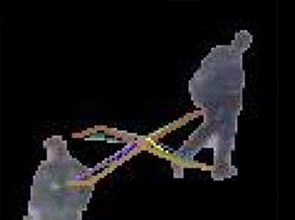
Most existing visual tracking systems do not handle crowded scenes well. Our
goal is to develop algorithms that take multiple sensory cues from the video
(e.g., target locations, colors, shapes, etc) and fuse this information to
robustly track in crowded scenes. We focus on the issue of occluding targets
- since this is where a lot of the difficulty in vsiual tracking arises. We
use sensory fusion to disambiguate occluding targets. This is a difficult
problem, since the process of occlusion gives rise to dramatic and
non-linear changes in the feature values. We exploit an approach that
determine which cues to use and how to best combine them by looking at the
distribution of feature measurement values to candidate targets - the
so-called rank-score behavior. Experimentally we have shown that this
approach, which we call the Rank and Fuse approach improves on a weighted
sum or mahalanobis-sum for fusion.
Automated Management of Multiple Camera Resources.
Our goal is to automate the process of switching between multiple cameras
when (manually or automatically) tracking a target. A major question in this
is to understand the connectivity between camera views. We have developed
algorithms and set of software libraries to automatically learn (using a NN)
the candidate handoff cameras for each camera in a building. The cameras do
not need to have overlapping views, exist and entrances can be anywhere in
the field of view, and no map is needed. Future work will include software
to periodically update the handoff information to account for camera or
building changes.
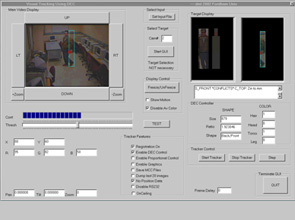
Combining Recognition with tracking: Discrete-Event Modeling of PTZ
targets
Most PTZ tracking systems decide when to pan, tilt or zoom based only on
providing the best operator view of the target. While the operator view is
clearly an important end-goal for tracking, it is not the only constraint
that needs to be acknowledged. A second constraint is that the tracker be
able to robustly recognize the target. There is no reason that these two
constraints should always agree, and ignoring the second constraint means
the operator may get an excellent view of the wrong target! We have
developed a discrete-event control approach to modelling the target shape
and color in such a way that we can determine when we need to zoom to
maintain recognition of the target as well as maintain the operator view.
Future work involves extending the discrete-event model to a hybrid model to
allow fine control of PTZ.
|
|
|
| |
|
|
|
|
|
|
 |
|
 |
|

14
 |
 |