|
Automotive
The optimization of processes in automotive production and at part suppliers
is a continuous task – because global competition and price pressures never
cease. Which is why every detail is always of decisive importance. SICK
sensors help exploit even the slightest efficiency potentials.
SICK sensor solutions make production safer, more rapid and more
transparent. Hazards and sources of errors are systematically eliminated and
individual production steps accelerated. All helping to make you, and your
production, a leader in global competition.
|
|
|
|
Press room
Assuring quality and meeting throughput targets whilst
maximizing protection for man and machine
In the production of body parts, quality and throughput targets must be
right. Therefore, SICK sensors are used in nearly all areas of the press
room – with its many automated press lines and robot assembly areas. They
ensure maximum readiness to deliver and direct the components and
ready-to-fit systems to the production lines – at the correct point in time.
|
 |
Body in white
SICK combines precision, speed and safety
The construction of body in white is one of the vital production steps in
automotive construction. This is where the various components are put
together for a strong and homogeneous vehicle base. The foundation of the
vehicle – the body – evolves.
SICK sensor solutions contribute to matching precision with speed and
safety.
|
|
Final assembly
The right components and modules, at the right time, in the right place.
This is the basic principle of final assembly. It centres on logistics and
quality. Only thus can the car, as a product, be produced perfectly and in
accordance with the customer’s wishes. Whether identifying bodies, inserting
screens, collision protection on suspended conveyors, supplying the wheels
and many other applications: SICK sensors are everywhere, to ensure fluid
processes.
|
|
Engine and gearbox production
SICK sensor solutions ensure precision and safety.
To ensure that engine components form a perfect whole, SICK sensors perform
vital monitoring, control and safety tasks in all areas of the “power
train”. For example, in checking for the presence of workpieces, control of
gantry robots, lubricants control in the engine or control of the workpiece
carriers on transfer lines – and, last but not least, in protecting
hazardous points and areas.
|
|
|
|
Part Supplier - Tier Ones
SICK provides more than sensor technology solutions
to all sectors of automotive parts production
Discover step by step how SICK “Sensor Intelligence” makes processes in and
around your automotive parts production faster, more efficient and safer.
Based on selected applications that we have illustrated as examples, we will
highlight the wide range of options provided by our intelligent sensor
solutions. See for yourself and discover your potential for optimization.
|
|
|
|
Seats
Prior to delivery the adjustments on the seats are
checked. An IQ80 inductive proximity sensor signals the presence of a
carrier and stops the transport. Two DME5000 distance sensors measure the
seat adjustments to be checked. For this purpose the worker pushes the seat
to its front and rear position and reads the two measured values directly on
the display on the bottom DME5000.
|
|
Motors
The ICR840 code reader reads the two-dimensional code
applied by a laser (direct part marking) to a camshaft and checks whether
the correct camshaft is fitted. The device sends the information to a
central computer for quality assurance.
|
|
Tires
Tire identification using the OPS890 bar code reading
system. The system comprises eight CLV490 line scanners arranged to reliably
detect the bar code on the tire bead. The reading system is triggered by two
WL18 (A) photoelectric reflex sensors that are arranged in an X-shape in the
reading zone to reliably detect the tire. Two further WL18 (B) photoelectric
reflex sensors arranged one over the other provide fast pre-adjustment of
the position of the focus of the code reader.
The large depth of field of the devices does not require any further
adjustment.
|
|
Assembly of small parts
A handling robot fits two sealing rings to injection
nozzles. It picks up the injection nozzle from the conveyor belt and places
it in the receptacle on the assembly table (process not shown here). A WT12L
laser photoelectric proximity sensor monitors for presence in the receptacle
and the exact positioning of the nozzles. The rings are supplied on two
vibration conveyors. WF fork sensors mounted at the outlet on the conveyors
control the vibration conveyors such that rings are always available. IQ05
inductive proximity sensors check the presence of rings in the two pick-up
stations. The handling robot collects a ring using end effectors attached to
its pivoting arm and fits it to the nozzle.
|
|
|
|
Electronics industry
Solutions for the automation in the Electronics
Industry
|
|
|
|
Wafer processing
Semiconductor front-end
Clean-room conditions, aggressive media, high temperatures, poorly
accessible sensor locations – wafer processing and quality assurance make
extreme demands on detection and safety technology. These sensor systems
from SICK are ready for them: compact, robust, easily installed, reliable
and powerful.
|
|
Chip assembly
Semiconductor back-end
Those who produce chips cannot afford to make any compromises. Too much
depends upon the quality of the components. Production process requirements
are correspondingly high. From detecting the presence of “naked” lead frames
in a stack, to inspecting the quality of finished encapsulated and separated
chips – SICK sensors permit assured production with high cycle speeds.
|
|
PCB assembly
The production of electronic circuit boards is subject to
particular price pressure, whereby the quality must be right. High-end
results in maximum possible cycle speeds – SICK sensors and camera systems
permit increases in performance at all points of PCB assembly, from the
first loader contact to feeding of the assembled circuit boards to the
soldering oven.
|
|
Final assembly
Electronic products
Controlling conveyor belts, checking occupancy, identifying workpieces – the
final assembly of electronic products demands versatile, flexible and
economical sensor solutions. SICK offers precisely the product portfolio
required: distance sensors, vision cameras, photoelectric sensors, proximity
sensors, bar code readers and safety systems – technically sophisticated and
proven in the most varied of applications.
|
|
|
|
Solar Industry
Solar cell processing
|
|
|
|
The future-oriented solar sector: the more efficient the
production of cells, the more reasonably priced this environmental
technology – and the quicker it will assert itself.
SICK makes a decisive contribution towards accelerating processes.
Protecting hazardous points-of operation, checking presence, production
steps in wet areas, contour measurement and quality inspection: SICK sensors
support your automated solar cell production.
|
|
Solar module assembly
During the assembly of solar modules, solar cells are
combined, framed and encapsulated for weatherproofing to form larger units –
the modules. SICK sensors have a key position in each individual step of the
process – from the stringer, through foil attachment and lamination, to
quality assurance and handling of the end product, the solar module.
|
|
|
|
|
|
|
|
Packaging Industry
The packaging industry needs sensors and sensor
systems that are designed for complex, frequently changing tasks, while
meeting increasingly demanding brand protection, safety and documentation
requirements. From the robust, IP69K photoelectric switches for detecting
glass, through intelligent camera sensors for inspecting the position of
packaging components, to complex laser systems for controlling loading
robots – SICK systems meet your requirements in every way. With considerable
advantages regarding performance, networkability and flexibility.
|
|
|
|
Filling of beverages
Identifying transparent objects (e.g. PET bottles),
coping with contamination, detecting positions in the process, and all of
this at high speeds – the robust sensors from SICK have been “at home” in
rotative filling systems for decades and offer correspondingly optimized
performance.
|
|
Filling of dairy products
Composite cartons have proved ideal (because hygienic),
nutrition-retaining, economical and logistically advantageous primary
packaging of drinks, dairy products and other liquid foods. The steps from
the box to correctly filled packaging are many and varied. Leading in the
process – from start to finish: efficient sensor solutions from SICK.
|
|
Packaging of meat goods
The hygienic demands of food legislation force the
meat-processing industry to make special efforts during the construction and
operation of their machines and plant. Temperature, humidity and the
stipulated plant cleaning cycles with caustic solutions can drastically
affect machine technology, and particularly the electronics. After many
decades of proven performance and reliability under the harshest of
conditions, inductive sensors, photoelectric switches and hand-held scanners
from SICK have lived up to the challenge.
|
|
Packaging of bulk materials
The sensors in bag packaging machines control the cutting
of the bags, regulate their filling, and check the sell-by date. The
solution for the entire process chain is illustrated here using the example
of cereal packaging.
|
|
|
|
Packaging of single products
Inserting a variety of chocolates correctly and rapidly
in the right mix is a task whose solution requires a highly complex robot
system. Motor feedback systems from SICK are ideal “feelers” for all pick &
place robots.
|
|
Labelling machines
Attaching small, thin labels and reliably checking them,
even if they are strongly reflective is critical for a labelling machine.
Photoelectric sensors and photoelectric proximity sensors provide the
necessary sensitivity to allow them to shine in labelling machines –
reliably at maximum work speeds.
|
|
Cartoners
The cartoning of articles is a complex process, in which
SICK sensors take on the most varied of tasks. IO Link, the innovative
interface from SICK, ensures maximum process efficiency and rapid,
comfortable conversion during format changes.
|
|
Code printers
The pharmaceutical industry cannot afford any mistakes –
neither in primary nor in secondary packaging of medicaments. SICK sensors
recognize all poorly printed codes and reliably inform the machine
controller.
|
|
|
|
Beverage
|
|
|
|
Filling of beverages
Identifying transparent objects (e.g. PET bottles),
coping with contamination, detecting positions in the process, and all of
this at high speeds – the robust sensors from SICK have been “at home” in
rotative filling systems for decades and offer correspondingly optimized
performance.
|
|
Filling of dairy products
Composite cartons have proved ideal (because hygienic),
nutrition-retaining, economical and logistically advantageous primary
packaging of drinks, dairy products and other liquid foods. The steps from
the box to correctly filled packaging are many and varied.
Leading in the process – from start to finish: efficient sensor solutions
from SICK.
|
|
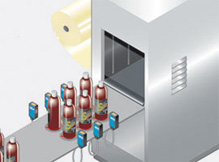
Shrink tunnels
Secondary packaging with shrink foil has become firmly
established in the beverage industry. A proven ensemble of SICK sensors
handles the fine work and final inspection.
|
|
Despatch box
Differing package shapes and sizes, the handling of
packaging materials including protection of hazardous points-of-operation,
ensuring material flow, differing reading distances for ID carriers: those
who develop plants for industrial final packaging face a wide variety of
tasks. Then there are the quality demands: the goods must arrive to
customers in perfect condition. It is good to know that there is a partner
that offers the sensors, safety and bar code reading systems from a single
source: SICK, the solution for final packaging plants of all types.
|
|
|
|
Food
|
|
|
|
Packaging of meat goods
The hygienic demands of food legislation force the
meat-processing industry to make special efforts during the construction and
operation of their machines and plant.
Temperature, humidity and the stipulated plant cleaning cycles with caustic
solutions can drastically affect machine technology, and particularly the
electronics. Many decades’ proven performance and reliability under the
harshest of conditions: inductive sensors, photo electric sensors and
hand-held scanners from SICK.
|
|
Packaging of bulk materials
The sensors in bag packaging machines control the cutting
of the bags, regulate their filling, and check the sell-by date.
The solution for the entire process chain is illustrated here using the
example of cereal packaging.
|
|
Packaging of single products
Inserting a variety of chocolates correctly and rapidly
in the right mix – a task whose solution requires a highly complex robot
system.
Ideal “feelers” for all pick & place robots: motor feedback systems from
SICK.
|
|
Labelling machines
Attaching small, thin labels and reliably checking them,
even if they are strongly reflective: photoelectric sensors and
photoelectric proximity sensors provide the necessary sensitivity to allow
them to shine in labelling machines – reliably at maximum work speeds.
|
|
|
|
Palletiser robots
Differing package shapes and sizes, the handling of
packaging materials including protection of hazardous points-of-operation,
ensuring material flow, differing reading distances for ID carriers: those
who develop plants for industrial final packaging face a wide variety of
tasks. Then there are the quality demands: the goods must arrive to
customers in perfect condition. It is good to know that there is a partner
that offers the sensors, safety and bar code reading systems from a single
source: SICK, the solution for final packaging plants of all types.
|
|
Stretch-wrapping machines
Differing package shapes and sizes, the handling of
packaging materials including protection of hazardous points-of-operation,
ensuring material flow, differing reading distances for ID carriers: those
who develop plants for industrial final packaging face a wide variety of
tasks. Then there are the quality demands: the goods must arrive to
customers in perfect condition. It is good to know that there is a partner
that offers the sensors, safety and bar code reading systems from a single
source: SICK, the solution for final packaging plants of all types.
|
|
|
|
|
|
|
|
Consumer goods
Cotton buds, scented sprays, washing powder,
detergents or packages of nappies and diapers – the tasks in the hygiene
article (or consumer good?) industry vary greatly. SICK’s professional
solutions for secondary and final packaging are particularly important here.
Differing product sizes and packages require machines with maximum
flexibility and a wide range of intelligent and network-enabled sensors. You
can develop efficient packaging plants throughout all the processes of this
sector with laser systems and camera sensors from SICK.
|
|
|
|
filling of detergents
Identifying transparent objects (e.g. PET bottles),
coping with contamination, detecting positions in the process, and all of
this at high speeds – the robust sensors from SICK have been “at home” in
rotative filling systems for decades and offer correspondingly optimised
performance.
|
|
Filling of tooth paste
Tubes are practical and particularly robust containers
for semi-liquid goods. Tubes carry a wide variety of brand messages to
consumers. The industrial filling and sealing processes involve a variety of
tasks for sensors, e. g. turning tubes to the correct position. Sensors from
SICK keep everything in view and under control.
|
|
Labelling of shampoo bottles
Attaching small, thin labels and reliably checking them,
even if they are strongly reflective: photoelectric switches and
photoelectric proximity switches provide the necessary sensitivity to allow
them to shine in labelling machines – reliably at maximum work speeds.
|
|
Despatch box packaging
Differing package shapes and sizes, the handling of
packaging materials including protection of hazardous points-of-operation,
ensuring material flow, differing reading distances for ID carriers: those
who develop plants for industrial final packaging face a wide variety of
tasks. Then there are the quality demands: the goods must arrive to
customers in perfect condition. It is good to know that there is a partner
that offers the sensors, safety and bar code reading systems from a single
source: SICK, the solution for final packaging plants of all types.
|
|
|
|
Pharma & Cosmetics
|
|
|
|
Filling of pharmaceuticals
A sensitive topic – literally: the filling of syringes in
the pharmaceutical sector.
Maximum hygienic and process reliability demands apply here. The technology
of choice, when minimum tolerances matter to the filling process:
high-performance sensors from SICK.
|
|
Filling of hygiene articles
Sensors for linear bottle filling must be versatile.
Robust, powerful and meeting all demands:
sensors, safety switches and photoelectric sensors from SICK.
|
|
Packaging of medicaments
Tablets in blister packs, correctly printed with brand
labels and use-by date, ready for comfortable individual removal – what
seems so convincingly simple as an end-product makes complex demands on the
packaging process in the pharmaceutical industry.
Accurate filling, precise sealing, detection of breaks, and freedom from
dust are merely examples of the extensive performance profile. Your partner
for the complete solution: sensor systems from SICK.
|
|
Labelling machines
Attaching small, thin labels and reliably checking them,
even if they are strongly reflective: photoelectric sensors and
photoelectric proximity sensors provide the necessary sensitivity to allow
them to shine in labelling machines – reliably at maximum work speeds.
|
|
|
|
Wood Industry
The demands on the wood industry are diverse and
sophisticated. Fast, safe and efficient production processes are
indispensable for high productivity in the saw mill, engineered wood, veneer
and furniture industries. SICK offers a variety of perfected products and
complete system solutions, which lead to optimized production results. As a
technology leader in many areas, and as the worldwide leading developer and
manufacturer of intelligent sensor technology, SICK has extensive expertise
gained from many years of experience in factory, logistics and process
automation. Let SICK help you optimize your processes in the wood industry.
|
|
|
|
Transport
- Commissioning with RFID and volume measurement
- Access protection
- Height measuring and position detection
- End position detection
|
|
Log sorting
- Log measurement
- 3D log measurement
- Height measuring and diameter detection
- Access protection
|
|
Transport and scrap wood disposal
- Quality determination
- Volume determination
- Distance measurement
- Filling level measurement with radar
- Filling level measurement with rotating paddle switch
|
|
Saw line
- Cant measurement
- Wane measurement
- Board detection
- Cant detection
- Position detection
|
|
|
|
Sorting & stacking line
- Lumber measurement
- Hazardous point-of-operation protection
- Filling level and board detection
- Board detection
- Path measurement
- End postition detection
|
|
Veneer peeling
- Log measurement
- Veneer measurement
- Distance measurement and end position detection
- Access protection
- Path measurement
|
|
Planer and cross-cut saw
- Cross cutting calculation
- Quality determination
- Access protection
- Package ejector
|
|
Panel dividing saws, edge-banding machine, machining
center
- Hazardous point-of-operation protection
- Board detection
- End of material detection
- Access protection
- Width measurement
|
|
|
|
Warehouse and Distribution
|
|
|
|
Receiving area
- Pallet storage and retrieval
- Automated conveyor loading
- AGV contour navigation in shipping/receiving
- Extendable conveyor loaders
- Forklift automation and safety
- Depalletizer station
|
|
Receiving process
- DWS (Dimension, Weighing, Scanning) – vision-based scanning systems
- Conveyor safety pulls
- RFID bulk scan in shipping/receiving areas
- Hand-held scanners in the receiving process
- Hand-held scanners for reading 2D codes in the receiving process
- Accumulation conveyor/retrofits
|
|
Put away process
- RFID pallet tag reading/writing
- Pallet overhang detection
- Automated pallet storage safety
- Tote fill check and scan
- Empty tote detection
- Pallet detection
- Pallet load profiling
|
|
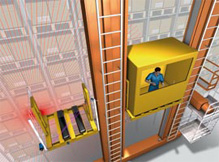
Automatic storage and retrieval systems
- Pallet transfer car
- ASRS alignment and obstruction detection
- ASRS unit load automation
- ASRS unit load fine positioning
|
|
|
|
Manual warehouse areas
- Vehicle height monitoring
- High bay empty storage confirmation
- RFID bulk scan in shipping/receiving areas
- Forklift anti-collision
- Automatic package/pallet identification from forklifts
- Storage area access control
|
|
Cold storage
- Pallet transfer car (cold storage)
- Pallet detection
- ASRS alignment (cold storage)
- Cold storage muting
- Cold storage AGV
|
|
Conveying and storage
- Overhead conveyor collision prevention
- Overhead conveyor safeguarding
- Overhead conveyor guidance and positioning
- Overhang/garment conveyors
- Tote identification and sorting
- Conveyor gapping
- Vertical storage system safety
- Sort conveyor switching
- Vertical storage safety and height detection
|
|
Pick process
- Tote picking and case breakdown
- Picking error detection
- Pick station error-proofing
- Pick quantity verification
- Manual pick verification
- Pick-to-light manual picking stations
|
|
|
|
Products and applications for the Machine Tools Industry
The machine tools sector represents a wide spectrum.
Whether presses, milling machines, turning tools, cutting or sawing
machines, and much else besides; whether large processing centres or small
stand-alone equipment – all of them require control, protection, inspection
and monitoring.
SICK sensors and sensor systems cover the whole range of these requirements
– thanks to a wide variety of products.
|
|
|
|
Protecting a press brake
Both the front and the back of a hydraulic press brake
are protected with a safety camera system and a host/guest system,
consisting of a multiple light beam safety device and a safety light curtain
to prevent access from the back
|
|
Safe functions in the production area: material removal
point on a racking station
The racking station before a robot cell is protected with
a safety light curtain. A multiple light beam safety device with a deflector
mirror provides access protection behind the racking station. The two
sensors are therefore active alternately.
|
|
|
|
|
|
|
|
Products and applications for Logistics
Every day, problems delay and interrupt port
operations – either completely or partially – all over the world. For
minutes, hours or even longer. As a result, every year a lot of money is
wasted reparing port equipment or because of damage to the transported
goods.
SICK's scanners help terminal operators to considerably reduce the
probability of collisions between cranes, vehicles and goods. Though SICK
products have also become indispensable for the positioning of cranes or
containers .
|
|
|
|
Positioning a truck below a ship-to-shore crane
HGVs transport temporarily stored containers from stacks
to ship-to-shore cranes. Laser measurement systems determine the position of
the HGV below the crane
|
|
Reading ladder-type bar codes on packages
Packages at a package distribution centre must be
assigned to the correct post office. A line scanner reads the information
contained in a bar code attached to the side of the package.
|
|
Collision protection in the working area of a crane jib
on a ship-to-shore crane
Packages at a package distribution centre must be
assigned to the correct post office. A line scanner reads the information
contained in a bar code attached to the side of the package.
|
|
|
|
|
|
Waste Incineration Plant
Waste management today is increasingly supported by
incineration processes. Here the organic compounds of waste are used to
produce energy in waste incineration plants or as alternative fuel in cement
kilns or even coal fired power plants. For the emission of these plants
special regulations are applicable where as the emission limits are more
stringent than for conventional power plants.
SICK analyzing systems are highly qualified for waste incineration
applications. With its wide range of products SICK is able to provide the
optimal solution for all relevant parameters, even for the most stringent
European Waste Incineration Directive. SICK is the only manufacturer with
own solutions for dust, gas flow, pollutants, reference gases, and data
evaluation systems.
|
|
|
|
Combustion optimization and control
Combustion processes require O2 to react chemically with
the fuel. Incineration of waste materials converts the waste into ash, flue
gas, particulate, and heat, the latter can be used to generate electric
power (waste to energy). O2 is supplied to the combustion process via
combustion air. Monitoring the O2 concentration at the boiler outlet is the
most important measure for control and optimization of the incineration
process.
Our solution:
- Oxygen analyzer ZIRKOR302
|
|
SNCR flue gas denitrification
Due to environmental protection NOx emissions have to be
reduced prior to the release into the atmosphere. In the NOx control process
with selective non-catalytic reduction (SNCR) either gaseous ammonia or a
mixture of urea and water is sprayed directly into the combustion chamber at
temperatures between 900 °C and 1.100 °C. Here NOx molecules react with the
ammonia compounds and form nitrogen and water. The NOx emissions are reduced
accordingly. In addition to O2 (boiler efficiency), NO is monitored at the
boiler outlet for control and optimization of the DeNOx process. With the
same system HCl, SO2 and H2O concentrations can be monitored as important
control parameters for a subsequent scrubber.
Our solution:
- O2 measurement: Oxygen analyzer ZIRKOR302
- NOx/HCl/SO2/H2O measurement: Analyzing system MCS100E
|
|
SCR flue gas denitrification
For the process with selective catalytic reduction (SCR )
gaseous ammonia is fed into the catalyst inlet. The conversion of NOx into
water and nitrogen takes place at temperatures between 200 °C and 400 °C. At
the inlet of the catalyst NO concentration is monitored to control the
ammonia injection. At the outlet of the catalyst NO and NH3 are measured:
The NH3 concentration (ammonia slip) indicates the efficiency of the
denitrification process while the NO concentration is monitored to ensure
compliance with the environmental regulations.
Our solution:
- NO measurement: Gas analyzer GM32
- NH3 measurement: Laser gas analyzer GM700
|
|
Flue gas scrubber
After the dedusting typically scrubbers are used to
remove acidic gases like HCl and SO2. Two scrubbing processes are used, wet
scrubbers and (quasi-)dry scrubbers. In wet scrubbers the flue gas is
sprayed with an aqueous mixture of water and lime. The gaseous acidic
pollutants react with the liquid to form gypsum which can be removed from
the waste water to produce drywalls. Using the dry scrubbing process the
aqueous solution is replaced by lime powder or a pasty mixture of water and
lime. For proper operation control of the dry process continuous monitoring
of HCl, SO2 and H2O concentrations is essential.
Our solution:
- Analyzing system MCS100E HW
|
|
|
|
Cement Industry
Optimized cement production by intelligent analysis
An economic cement production strongly depends on energy efficiency in
production processes and on securing a high product quality. Hereby, the
co‑incineration of alternative fuels in substituting primary fuels is
gaining more importance. Therefore it is necessary to continuously monitor
the processes with analyzing systems, also in order to comply with the
relevant emission limit values.
SICK analyzing systems are highly qualified for cement applications. With
its wide range of products SICK is able to provide the optimal solution for
all relevant parameters, even at high temperature and / or high dust
conditions. SICK, is the only manufacturer with own solutions for dust, gas
flow, pollutants, reference gases, and data evaluation systems.
|
|
|
|
Coal bunker / Coal mill
Pulverized coal is a common fuel in a cement plant. Due
to safety reasons, monitoring of CO concentration in coal bunkers and coal
mills is an essential issue. Increasing CO concentrations may indicate a
smouldering fire and require immediate counter measures. In addition, O2
concentrations provide significant information for coal mills which are
operated under inert gas purging: By monitoring the oxygen concentration
during the grinding process the entrance of false air into the system can be
detected at an early stage. Herewith the danger of explosion or fire can be
minimized.
Our solution:
- Analyzing system MKAS Compact
|
|
Kiln inlet
The raw material enters the kiln via pre-heater and pre-calciner.
ln the kiln, the sintering process takes place at temperatures up to 1.400
°C. The final product, clinker is leaving the kiln at the opposite end for
further processing. Producing high quality clinker is requiring accurate
control of energy input: Insufficient heat will leave unconverted lime while
excess heat increases fuel consumption and could damage the kiln. Energy
input and optimal combustion conditions can be derived from gas analysis
data taken from the process gas at kiln inlet. Application task is to
continuously monitor the concentration of CO, NO and O2 and in some cases
CO2 and SO2 inside the kiln close to the raw material inlet under extreme
conditions. Our solution:
- For gas sampling: Sampling system SCP3000
- For gas analysis: Analyzing system MCS100E HW
|
|
Pre-heater and pre-calciner
In addition to the rotary kiln, modern cement plants are
equipped with a multistage cyclone pre-heater and a pre-calciner. The
pre-heater is using the excess heat from the kiln and the pre-calciner.
Pre‑heating and pre‑calcining of the raw material shorten the sintering
process in the kiln, the overall fuel consumption is reduced. Control
parameters at the pre-heater are CO, NO, O2 and SO2. Our solution:
- Analyzing system MKAS with analyzer SIDOR
|
|
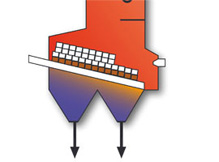
Dedusting
For environmental compliance the exhaust gases from the
production processes have to be dedusted. In addition, the dedusting
processes are used for material recovery ( e.g. in the coal mill).
Electrostatic precipitators are commonly used for dedusting of the hot
exhaust gases from pre-heater, pre-calciner and kiln. For cold exhaust gases
(from coal mill, etc.) and for material recovery bag filters are used. In
order to detect bag leaks and to ensure compliance with the relevant
emission limits SICK dust analyzers are used.
Our solution:
- Dust monitor DUSTHUNTER SP100
|
|
|
|
Building Automation
Comprehensive building automation with tailor-made
sensor solutions
Bridge up any security gaps before they appear.
The business field Building Automation has the task to fulfill the customer
needs of security, protection and control for buildings and facilities.
We can offer you a wide range of effective options for managing and
protecting your property. In building automation, the global perspective
counts, which is why SICK is represented all over the world. As an
independent partner, we will accompany you at all times and be quickly to
hand. The sooner you involve us in your planning, the more effectively our
consultation will aid your planning and implementation of certified and
high-performance solutions.
|
|
|
|
Perimeters/Fences/Walls
For building automation of a perimeter, fence or wall, we
distinguish two application areas area monitoring and location indicator
systems.
With area monitoring, software in the sensor will manage all monitoring
areas. The system signals if intruders are present by releasing the
switching output and triggering an alarm whenever an area is violated. This
may, for instance, also be triggered by objects or items regardless of
whether they are mobile or not.
The sensor uses the measuring data with which it has been provided to
determine the location.
When this is done, the devices are set so that small animals, adverse
weather conditions or mere passers-by do not trigger any false alarms.
Another important feature is that the devices take privacy into account
|
|
Open spaces
SICK laser scanners are usually used horizontally for the
monitoring of open spaces. If necessary, several reporting levels can be
defined for each scanner (standard function). Approach roads and access
paths can also be suppressed so that disruptions to pedestrians or road
traffic are prevented. As a result, separate, differentiable alarm
notifications are generated. Disruptions due to adverse environmental
conditions are intercepted first by the scanner ensuring a low rate of false
alarms.
Using these separately output signals, the selected area can be monitored
and available cameras controlled via a monitor. This has the benefit that
monitor images are displayed according to the incident, considerably
reducing the onus on security guards. Further benefits include the shape of
areas being user-definable and simple installation on buildings.
|
|
Facades
Laser scanners are usually used vertically for the
monitoring of facades. The size of the monitoring areas and the possibility
of setting several scenarios (see example of night/day mode) means only a
few systems will be required, making protection as effective as it is
inexpensive.
The building's floor outline or fence serves as the reference contour. This
is constantly inspected by the system to see it remains intact (distance
measurement). Deviations in this outline, e. g. due to movements of earth
(excavation) in the monitoring area or manipulation of the laser scanner
(dismantling) trigger an alarm. The scanners are highly resistant to
environmental influences like rain and snow, making the rate of false alarms
very low, something which has also been confirmed by TÜV Süd.
|
|
Roof Protection
With flat roof protection, SICK laser scanners are
generally installed directly on the building. This removes the need for
expensive installations or attachments on the roof. The monitoring area for
the system is set up approx. 30 cm above the ground so that any persons
crawling under the alarm zone are detected and registered. The edge of the
monitoring area can also be placed slightly above the edge of the roof so
that any ladders, for instance, are detected at once. The arrangement of the
monitored areas, the choice of object size to be detected and flexibly
adjustable response times mean any movement of animals, birds or leaves
through the monitored area will not trigger an alarm (filter function).
|
|
|
|
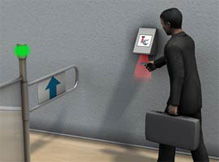
Access control and door/gate monitoring
Areas such as gates and turnstiles can be monitored
either using active-switching sensors or a sensor system, which recognizes a
special code and then reliably provides access. To do this, either tried and
tested bar code reading technology or newer technologies such as RFID with
the ISO 14443 standard (special encryption) are available.
Active-switching 2D and 3D sensors and photoelectric sensors, light grids,
laser scanners and camera systems (see below) provide a range of options for
access detection. The sensor system can be set either so that it recognizes
whether an unauthorized person is trying to enter or else how many persons
enter a room in order to control parallel systems such as heating, air
conditioning or ventilation.
|
|
Indoor areas
Paintings and sculptures need to be protected from
deliberate or accidental vandalism and against theft. Unintentional contact
in particular is a challenge for a sensor system as this must be reported
without the artistic enjoyment of curators, art lovers or other guests being
diminished. The more inconspicuous, precise and reliable protection is, the
more this requirement can be met without detriment to the protection. Laser
scanners are often used for protection of pictures/walls (vertical) or to
protect ceilings/floors (horizontal). For objects such as sculptures,
jewelry etc. in wall recesses, light grids have proven to be most
appropriate. Fast detection of any interference prevents any “angling” of
the object being monitored. Two-dimensional protection is sufficient for
paintings but with sculptures, a greater dimensional range needs to be
covered. A distance-measuring vision system can also be used for this
purpose.
|
|
|
|
|


 K
K