Uhing

Videos
Loading the player ...
- Offer Profile
- We provide
state of the art:
- Winding-Systems
- Rolling Ring Drive, Guide System GS,
- Non Contact Flange
Detecting System FA
- Automatic Winding Width Control AVS - Linear Drive Systems
- Rolling Ring Drive, Linear Drive Nut,
- Timing Belt Drive - Clamping Systems
- U-Clip, Uhing-easylock® - Engineering
- Winding-Systems
Product Portfolio
Clamping Systems
U-Clip and easylock®
- Shaft collar for smooth shafts/tubes U-Clip
The types U-Clip and Uhingeasylock® offer solutions for many problems at handling. U-Clip is using a clamping ring which is off-set to the shaft and therefore clamping forces are provided. Like a bushing the U-Clip is pushed foreward against the to be fixed component and it automatically locks into position. To release, just pull the clamping ring towards the user.
The Uhing-easylock® System is characterized by ease of handling and its clamping/ tensioning function on smooth shafts. The result is rapid roll changing combined with high but sensitively applied retaining pressures for spools and rolls of flexible width and with varying core diameters in a modular system suitable for a variety of applications. Its main component parts are a fixed pintle and a clamping section comprising a tensioning unit and an interchangeable pintle point. Its function relates to a clamping ring which is located in the tensioning unit and which is brought into pressure contact with the shaft. The greater the tensioning force, the greater is the clamping effect of the ring. The spool or roll is retained and fixed by pushing the tensioning unit up against it and turning the tensioning wheel until the required clamping force has been achieved. To release, the clamping force is reduced via the tensioning wheel and the clamping pintle is pulled off the shaft. Also suitable for driven shafts. 
Your benefit
-
- usage on hardened and soft surfaces
- self locking
- one hand operation
- symmetrical design
- high self locking force compared to ball systems with inclined level
- corrosion protected
- resistant against vibration
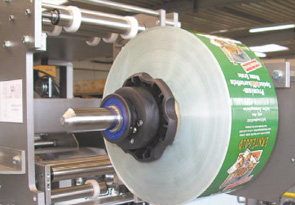
Area of application:
-
- Positioning on rotating and non-rotating shafts, e.g. wind-up and pay-off (not appropriate for torque transmission)
- Tube to shaft (or tube) connection, e.g. tripods
- Fixing components on shafts, e.g. dumb-bell weights
- Quick adjustment for material guiding, e.g.
packaging machines
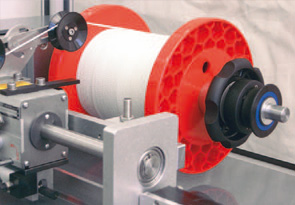
Operational Area
-
- Packaging
- Static application (fractioning sizer)
- Winding
- Driven shaft
- Tensioning of spools
- Tensioning of rolls


Uhing® Magnetic Clip - a magnetic core moulded in plastic
-
The Magnetic Clip is specially suited for applications
requiring little holding forces and easy cleaning. The holding force can be
varied by changing dimension s (length of the protruding shaft journal).
Rotationally symmetrical design
Uhing® Magnet Clip is used with untempered or tempered shafts of fit tolerance h11. The Clip also allows for larger shaft tolerances and is fully rotationally symmetrical. Uhing Magnet Clip fastens many things – from label reels, rollers and spools up to food industry products. The closed design of the Magnetic Clip makes it easy to clean, a major benefit for foodstuff applications.


Linear Drive Systems
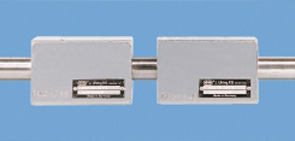
Uhing - Linear Drive Nut
- Uhing Linear Drive Nuts are non-positive drives which
convert the rotation of a plain shaft into linear motion. In contrast to
Rolling Ring Drives, the Rolling Rings are not arranged to swivel but are
fitted at a fixed angel of pitch, the speed being varied by varying the
speed of the shaft. The change of direction is achieved by reversing the
direction of rotation of the shaft.
Backlash-free, low noise, rolling-friction giving high-efficiency, combined drive and carrier, release mechanism enables unit to be manually positioned on the shaft, compact design, small space requirement, safe as it will slip when overloaded, thrust can be multiplied by ganging-up units, available with a variety of pitches, leftand
right-hand pitch on the same shaft possible, good sealing possibilities e.g. for use in dusty, dirty or humid environments. Wherever linear motion is required, the Uhing Linear Drive Nut is a modern alternative to hydraulics and pneumatics, chain drives and lead srews. 
Application areas
-
- Co-ordinate measuring machines
- Inspection technology
- Materials handling
- Conveyor systems
- Engine controls

Your benefit
-
- converts rotary motion into linear motion
- backlash free
- low noise
- low maintenance
- compact
- good sealing possibilities (plain shaft)
- drive can be disengaged on the shaft
- low operating costs
- comprehensive range of sizes
- resistant against vibration
- high corrosion protection
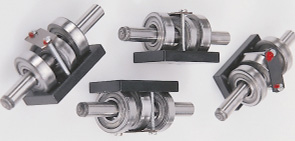
Special design for open Linear Drive Nuts upon request
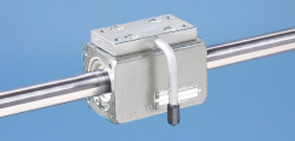
freemovement lever

linked nuts
left- and right hand pitch
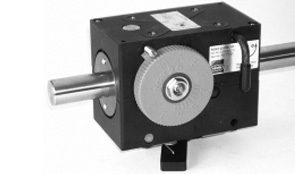
Uhing - Rolling Ring Drive RG, RGK
- The drive converts the constant rotation of a plain
shaft into a two way reciprocating motion and is also used in the general
linear motion area.
Accommodation of heavy loads and high forces when used in conjunction with
additional load carrier. Standstill on rotating shaft possible with a high
degree of repeat accuracy (external impulse restart). Suitability for
two-way shaft rotation.
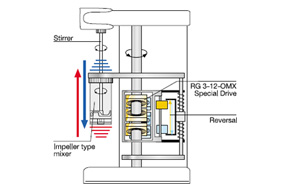
Pneumatic or electromagnetic reversal. In addition to our standard range, we
can supply you with tailormade solutions to your specific problems and
requirements.
Application areas- Surface treatment / Converting
- Measuring and testing
- Materials handling / Packaging
- Tyre manufacture
- Feeds / Positioning drives
- Power amplifiers (servo functions)
- Drives for synchronous cutting machines
- Sequential drives / Special machines
Remote control
- All functions (reversal, width of stroke, speed and
free-movement) can be remotely controlled.
Precise repeatability of movement sequences, including different characteristics in the two directions of travel, possible via cam follower control.

Rolling Ring Principle
- Rolling Ring Drives are friction drives which convert the
constant rotation of a plain round shaft into reciprocating motion.
They operate like nuts on a threaded bar, however the pitch both left-hand and right-hand is capable of fine adjustment or can be set at zero.This effect is achieved by using ball bearing based Rolling Rings which are designed to pivot about the shaft, their specially crowned running surfaces being pressed against the shaft as it rotates.

Your benefit
-
- automatic reciprocating motion with constant direction of shaft rotation
- side thrust up to 3600 N
- width of stroke up to 5m
- speed up to 4.2m/sec.
- suitable for horizontal and vertical application
- variable linear output speed from constant shaft input speed
- rapid or speeded down reversal
- high reversal position dynamics
- can be disengaged on the shaft
- good sealing possibilities (plain shaft)
- high efficiency
- low operating costs
- high corrosion protection
Mixer

Production of tarts
Cleaning with pressured water for conveyor belt

Winder „Moving Spool“-type
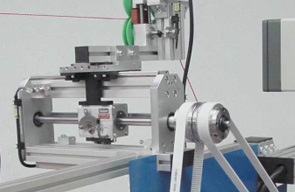
double winder

double winder
Linear Drives: Uhing®-Z-Drives - Uhing® Timing belt drives
-
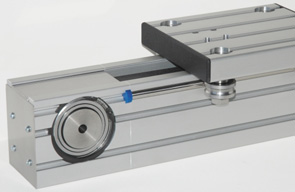
The basis of the Uhing Z -Drive is a bending and torsion resistent rigid
aluminium profile.
A number of T-slots in the carrier section offer variable extension possibilities and simplify assembly. Slide connection blocks can be easily inserted. The transmission of power from the drive belt to the load carrier is via belt fastener fitted to the carrier. Uhing-Z-Drives are characterized by the use of high grade materials including corrosion resistant hardened guide rails and robust timing belts which retain their shape. They are precise, positionally exact, reach high acceleration rates and speeds and are built for long life. 
Application area
-
- Drive technologies

Your benefit
-
- easy to fit
- precise guiding
- high linear speeds and rates of acceleration
- comprehensive range of types and accessories
Winding-Systems
Uhing®-Guide System GS
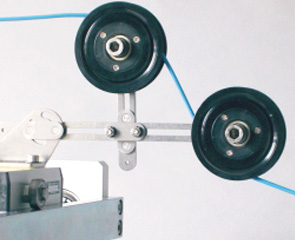
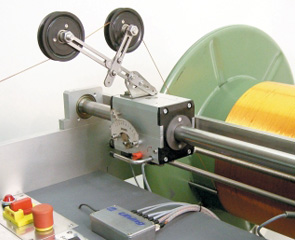
- Uhing®-guide system GS transmits the traversing movement of the traversing unit to the guide roller and the material to be wound. Additional modules allow the system to be universally matched to the winding task.
Advantages:- Modular construction for easy adaptation to the winding task
- continuously adjustable
- Torsionally rigid
- adapter for assambly on Uhing Rolling Ring Drives KI, RG15, RG20, RG22 and RG30
- made entirely of stainless steel
- versatile attachment options for guide rollers
- suited for all traversing systems
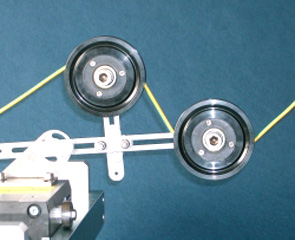
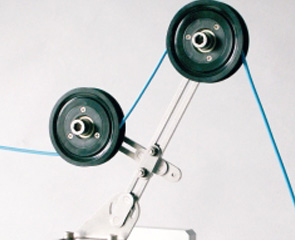


Uhing®-Non-Contact Flange Detecting System FA II
- Application
The flange detecting system detects the position of flanges on spools, regardless of the spool used. After a spool change, the system automatically adjusts to the new spool position and, where necessary, the new spool shape. The flange detecting system was specially designed for application with pneumatically reversible rolling ring drives but can also be fitted on other traversing systems after testing.
Your Advantage
• No manual adjustment of reversal points
• Significant time savings when spools of different type and dimension are used, because adjustment is not required
• Very easy operation
• No prior experience required
• Perfect winding patterns
• No machine data required from customer
• Robust sensor technology
• Modular system
Principle of function
The sensor detecting the flange is mounted on the traversing system. At a defined point, the current distance is captured and saved as reference distance for each single layer.
While the traversing system moves, the reference distance is continuously compared to the measured value. A reversal is triggered as soon as the permissible, adjustable height deviation is exceeded. Such a height deviation occurs when the flange or an accumulation of material on the spool is detected. A display indicates either the measured height or the permissible height deviation.
Areas of application
The system has been designed for laying round material with diameters of 0.1 to 2.0 mm on cylindrical spools. Other dimensions are possible after consultation. Spools of different sizes can be wound without readjustment. In this context, the diameters of the spool core (dcore) and the flanges (dflange) must be heeded. The difference must not exceed 220 mm (dflange - dcore < 220 mm).
When using several spools, the smallest core diameter and the largest flange diameter applies. Other spool sizes are possible as variant.
Flanges can be rectangular or conical up to an angle of 40°; the bulging of flanges is compensated for. Scanning of spools with collapsed flanges is not possible.
The traversing system must be mounted parallel to the spool axis. For very slow winding speeds, the axial run-out of the shaft carrying the spool should not be smaller than the smallest diameter of the material to wind.

