Creaform

Videos
Loading the player ...
- Offer Profile
- With headquarters in Lévis, Québec, Canada and Lake Mary, Florida, USA, FARO CREAFORM is the result of the combination of FARO’s renowned 3D Measurement business segment and Creaform’s innovative metrology solutions. With roots dating back to 1981, FARO has been a global leader in portable measurement arms, laser trackers, and reality capture technologies. Creaform, founded in 2002 in Lévis, Québec, has revolutionized handheld 3D scanning and automated inspection, serving thousands of professionals in automotive, aerospace, manufacturing, and research. Together, FARO CREAFORM empowers quality, production, maintenance and design teams to work faster, smarter, and with total confidence, unlocking better outcomes and superior experiences across manufacturing workflows. FARO CREAFORM is a business unit of AMETEK, Inc., a leading global provider of industrial technology solutions serving a diverse set of attractive niche markets with annual sales of over $7.0 billion.
Visit us on:


Product Portfolio
Portable 3D Scanners - HandySCAN 3D


HandySCAN 3D | EVO Series
-
Engineered for Accuracy, Designed for Usability
The HandySCAN 3D | EVO Series features a powerful embedded graphical user interface (GUl) that enhances user experience and efficiency while delivering Creaform's flagship metrology-grade qualities: proven reliability, renowned portability, and unmatched accredited accuracy.
By integrating augmented reality (AR) capability and a photo camera, the EVO Series further streamlines and enhances the inspection process—enabling QA and QC professionals to document part assessments better and faster, and execute workflows with greater efficiency.
The HandySCAN 3D | EVO Series stands out as the most powerful handheld 3D scanner on the market. It also features wireless capability and a robust 3D metrology software platform—providing a fully integrated solution, redefining ease of use, and empowering new users to quickly master the technology, all while also meeting the needs of the most advanced users.
HandySCAN 3D|BLACK Series
-
When Accuracy Meets Versatility in a 3D Laser Scanner
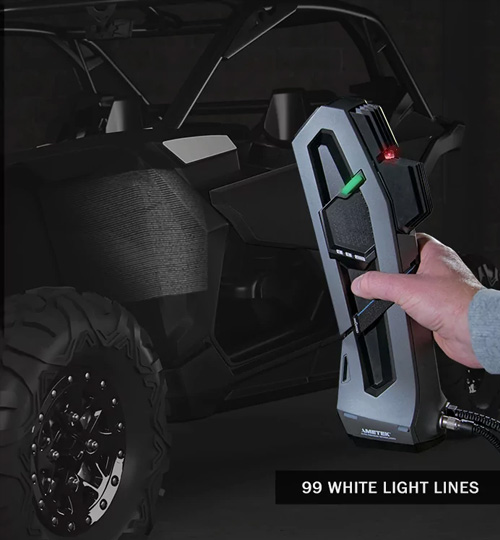
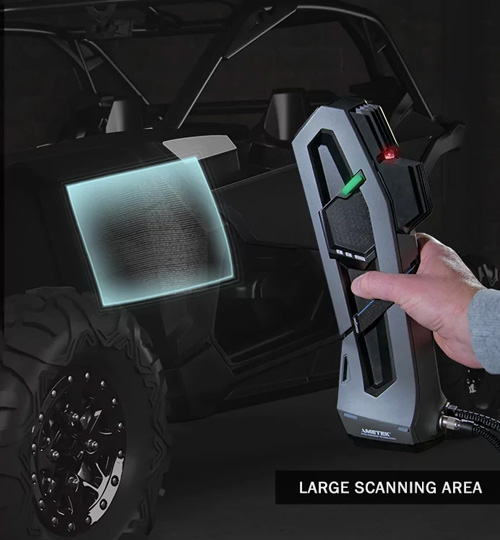
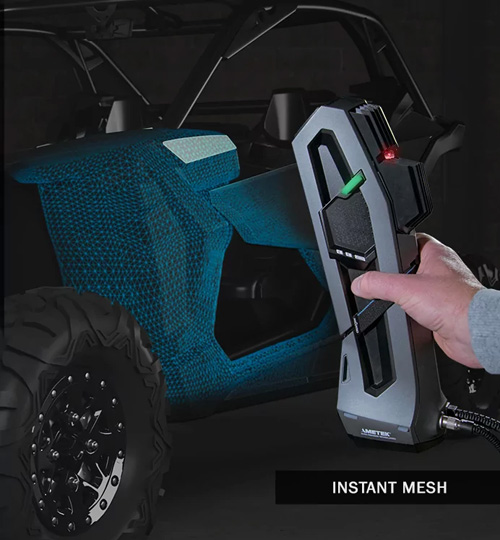
Optimized to meet the needs of design, manufacturing and metrology professionals, the HandySCAN 3D|BLACK Series is a metrology-grade handheld 3D laser scanner built for accurate and reliable 3D measurement across all part sizes, surface types, and materials. It delivers results within seconds, anywhere.
Certified based on the most rigorous industry standards, this fast and versatile handheld 3D scanner is easy to use and captures highly detailed measurements—even under challenging environmental conditions and on complex surfaces.


MAX Series
-
When accuracy meets versatility and portability.
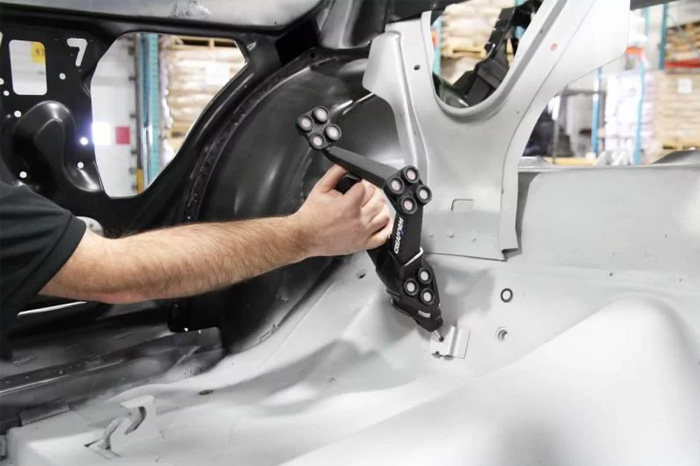
Combining the effect of portability, accuracy, speed, and simplicity, which are inherent to the HandySCAN 3D line-up, the new MAX Series is optimized to acquire highly accurate 3D measurements on large and complex parts typically present in the aerospace, transportation, energy, mining, and heavy industries.
Engineered to capture fine details and scan large volumes equally well, the HandySCAN 3D|MAX Series enables professionals to measure large parts and assemblies in a simpler scanning process, resulting in high-quality 3D scans in just a matter of minutes.


PRO-Serie
-
Top-Performance 3D Scanners Backed with Best-in-Class Scan-to-CAD Software
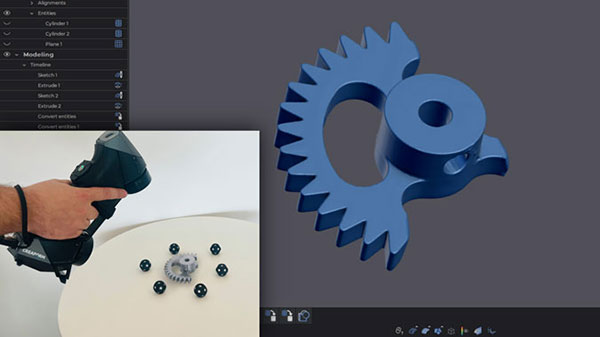
The key to an efficient reverse engineering workflow is converting 3D scan data into ready-to-use CAD and 3D print models as quickly and as seamlessly as possible.
To achieve this, product designers need a high-performance laser 3D scanner that is able to capture the finest details on any surface finish and perform reliably in any environment, all without compromising accuracy.
Equally important is choosing software that excels at advanced 3D scan processing, delivering powerful sketching and modeling tools to create the fastest, most streamlined path from scan to CAD, with the ability to compare 3D models directly against the original scan data.
The HandySCAN 3D | PRO Series, bundled with Scan-to-CAD Pro, offers a more powerful, accessible, and reliable solution to accelerate product development, reduce time-to-market, and lower development costs.


MetraSCAN 3D
-
Speed and accuracy combined with versatility
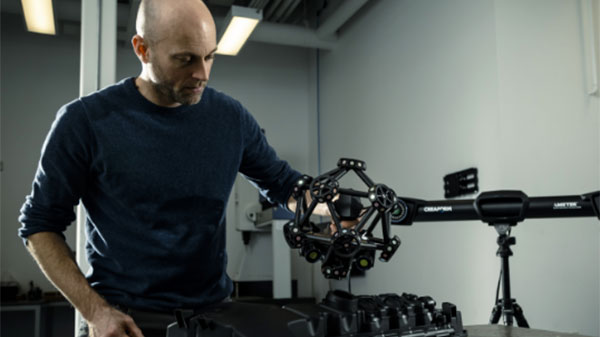
The MetraSCAN 3D optical CMM scanner line-up is specifically designed for manufacturing and metrology professionals who do not want to compromise on quality or efficiency. It can withstand any production environment, including shop floor vibrations, part movements and environmental instability—all while accelerating 3D measurement workflows. This optical CMM scanner has been engineered to perform highly accurate and repeatable metrology-grade measurements and 3D geometrical surface inspections.
When paired with the HandyPROBE, Creaform’s handheld optical coordinate measuring machine (PCMM) with probing capabilities, users can also harness the power of both 3D scanning and probing for complete, end-to-end inspection processes.


Go!SCAN 3D
-
Versatile White Light Scanner for Full-Color Object Scanning
The Go!SCAN 3D is our fastest, user-friendly handheld 3D scanner for objects. A powerful tool during the product development phase, the Go!SCAN 3D quickly measures any complex surface making it possible to “get it right” the first time. With its seamless integration to your 3D modelling software and your product life cycle management workflow, it will greatly improve product development, foster innovation and shorten time to market.
Designed to scan any object without need for a set-up, it offers flawless texture and geometry acquisition as well as impressive details in a rich color palette. Just go…and scan!
Automated quality control solutions
R-Series
-
Perform More Inspections with Fewer Resources and at Lower Costs
Designed for automated quality control applications, the R-Series™ 3D scanning solutions are perfect for manufacturing companies who want to increase their productivity by measuring more dimensions on more parts without compromising on accuracy in shop-floor environments.
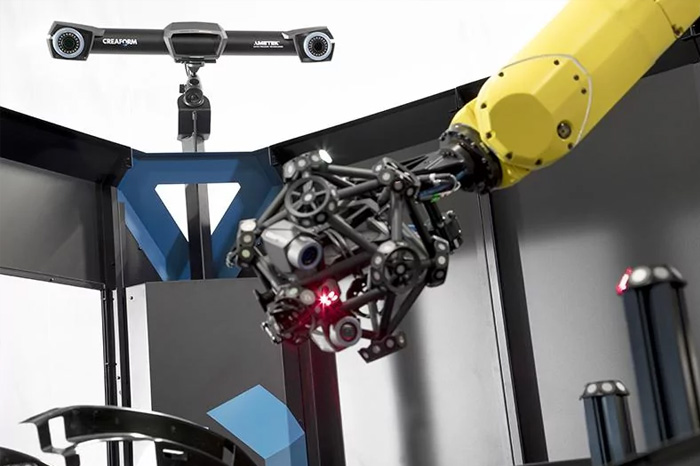
The MetraSCAN 3D-R™ is a powerful, innovative series of robot-mounted optical CMM scanners that can be seamlessly integrated into automated quality control processes for at-line inspection in mass production. Its cutting-edge technology enables manufacturing companies to detect quality issues faster.
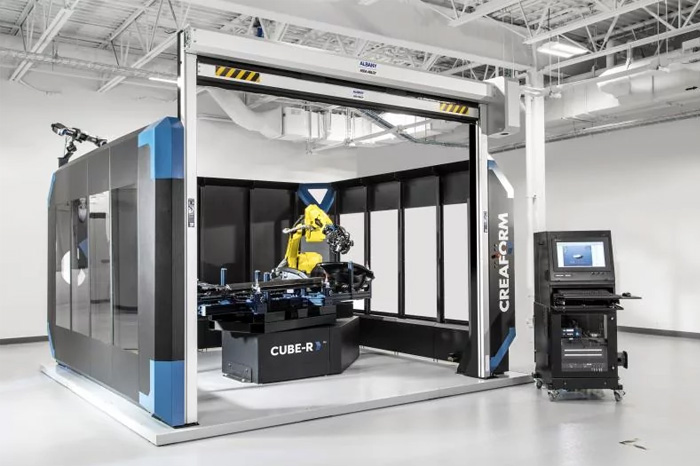
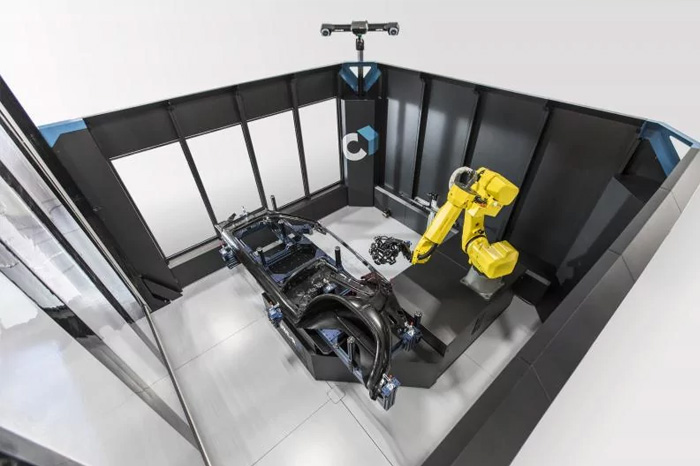
The CUBE-R® leverages the power of the MetraSCAN 3D-R in a high-productivity industrial measuring cell that has been designed to be integrated into factories for at-line inspections. Compared to traditional CMMs, the CUBE-R is much faster, providing a gain in productivity and better efficiency.
Coordinate measuring machines


HandyPROBE
-
Accuracy and simplicity combined with portability
The HandyPROBE™ line-up is a portable optical CMM specifically designed for use on the shop floor. Thanks to its metrology-grade accuracy and dynamic referencing capabilities, the HandyPROBE delivers unmatched accuracy regardless of the measurement setup, instabilities of the environment and user experience level.
Without the requirements of a rigid measurement setup, the complete measuring system—the part, optical tracker, and wireless probe—can all be moved freely at any time during the measurement sequence.
The HandyPROBE is simply the best metrology solution for measuring geometrical entities on parts of any size directly on the production floor.


MaxSHOT 3D
-
Elevate your measurement speed and accuracy on large parts
Creaform’s MaxSHOT 3D™, a photogrammetry optical coordinate system, is a game changer for product development, manufacturing, quality control and inspection teams. It is the ideal solution to achieve the highest measurement accuracy and efficiency for large-scale projects and parts from 2 to 10 m. Imagine obtaining accuracy levels better than 0.015 mm/m. Gain peace of mind knowing that your measurements are always right on the dot.
What’s more, thanks to sophisticated, proven user guidance technology and easy-to-use software, technicians of all levels—even non-metrology experts— can use the MaxSHOT 3D. Contrary to traditional photogrammetry, the MaxSHOT 3D features automatic feedback before final measurements captured. Never take a bad image again!
If you consistently work on large-scale projects, the MaxSHOT 3D is your go-to solution to slash budgetbusting measurement mistakes, improve product quality, increase process efficiency, and minimize overall operating costs.
3D Scanning, Metrology & CMM Solutions for Quality Control, Reverse Engineering, and NDT
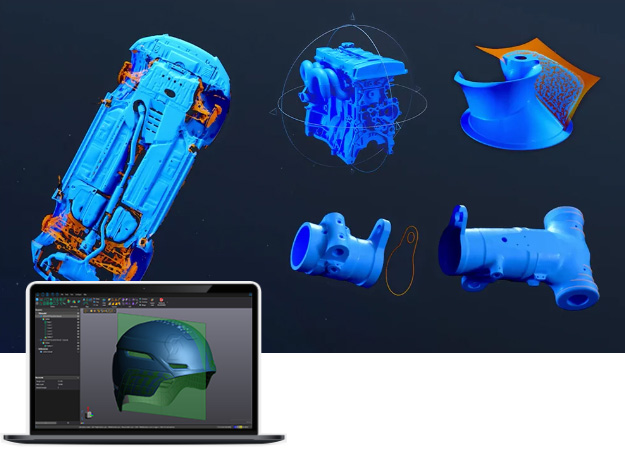
- From simple 3D scanning tasks to complex development projects, Creaform’s cutting-edge 3D metrology and CMM solutions improve quality, accelerate time to market, and support reverse engineering, quality control, and NDT applications while reducing costs.
Product Development and Design
- Product development refers to all of the stages involved in bringing a product to market—from inception through conception and engineering design to product development. Computer-aided design (CAD) software is used as a design tool to enhance product development.
As project managers, senior engineers, or engineering directors, you are responsible for finding ideas that lead to new product introduction. Innovation is the essential element that maintains your company’s competitive edge through the development of new technologies, new projects, new angles, and new niches that help you surpass your competitors.
As design engineers or industrial designers, you participate in all of the activities related to product development and implementation. You must first determine if the design intent is feasible and if all of the necessary tools and software to realize the whole project are accessible and available. Then, you design parts (often with complex shapes and geometries) and create 3D models while minimizing iterations in order to shorten the design cycle.
Reverse Engineering
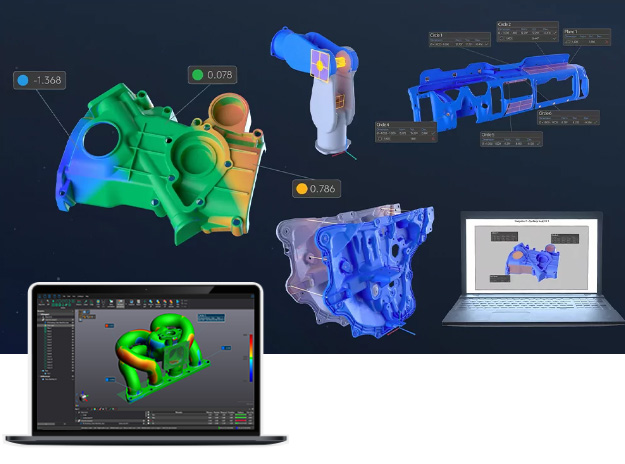
- Reverse engineering is a process that involves measuring a physical object and reconstructing it as a 3D model to recover the design intent—a perfect reconstruction of the original design—in terms of simple analytical surfaces (planes, cylinders, etc.) and freeform surfaces (NURBS) in order to produce a new reference CAD model.
As CAD engineers and industrial designers, you have the critical task of adapting and maintaining parts with shapes that are frequently organic and complex. Since the CAD models are often no longer available or difficult to find, you have to reconstruct the 3D models and integrate them into the design.
The reasons for reverse engineering are multiple: to replace damaged components (for which CAD models are nonexistent), to update obsolete parts, to fit new parts into a current assembly or environment, to generate new manufacturing plans, or simply to analyze competitors’ product features. 3D scanners are generally the preferred technology for extracting dimensional information and representing it as a point cloud or an automatic and instant mesh.
Quality control and Quality assurance
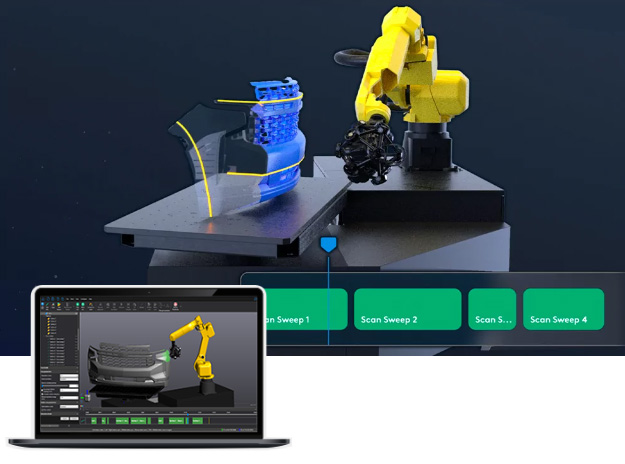
- Dimensional quality control (QC) is a process that measures the dimensions of manufactured parts to ensure that they adhere to a defined set of quality criteria and match customers’ requirements. Quality assurance (QA), on the other hand, consists of a set of procedures that prevent mistakes and defects in the different steps of the manufacturing process in order to avoid non-compliance when delivering parts to customers.
As QC managers, you have the delicate task of ensuring—even improving—the quality of the manufactured parts by applying effective controls performed with reliable, fast, and easy-to-use measuring equipment. You are also responsible for testing and validating the true performance of these instruments. Therefore, equipment unavailability, inefficiency, and limitations are obstacles to your work performance.
As QA engineers, you are in charge of investigating the problems raised by QC and production, performing the root cause analysis (often under pressure), and implementing corrective actions quickly to limit downtime. Through this process, you will also look for ways to improve the manufacturing process while minimizing production costs and lead time.
Maintenance, Repair, and Overhaul
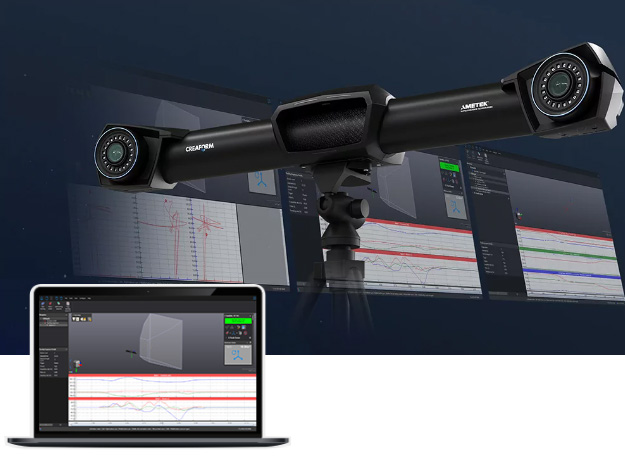
- Maintenance, repair, and overhaul (MRO) refers to any action, including tests, measurements, replacements, and adjustments, that helps to maintain or restore products, machinery, tooling, or plants to their working conditions. Planned, predictive, preventative, and corrective maintenance are the main forms of overhaul.
As structure engineers or maintenance managers, you are responsible for the integrity of parts, equipment, or infrastructure. You are in charge of characterizing and repairing defects according to the acceptance criteria detailed in the manufacturer’s manual. To do so, you have to find and apply the right repair methods or contact the OEM to determine if the measured data exceeds the acceptance criteria. Unreliable data and unrepeatable results complicate your work, as do user-dependent measurements. How can you characterize damages and take corrective actions if the measured data on the same structure differs from one operator to another? More importantly, how can you make the right repair decision knowing that important operational and safety issues are often at stake?
Non-destructive testing (NDT)
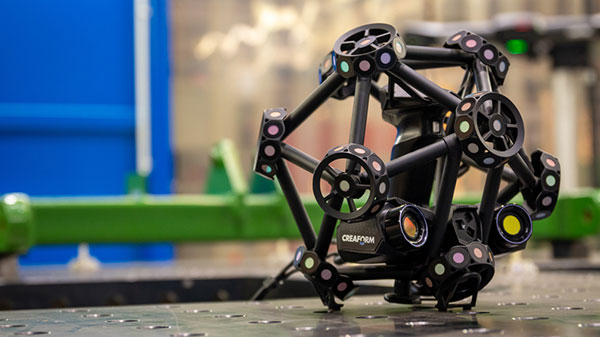
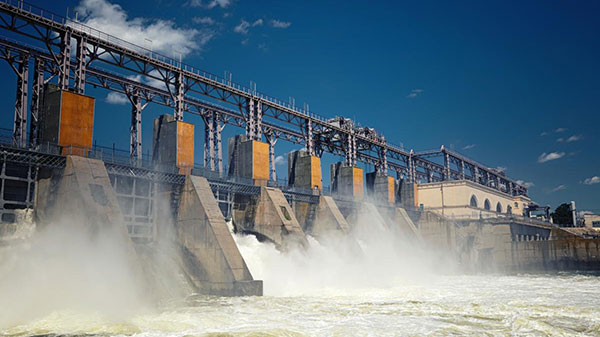
- Non-destructive testing (NDT) is an inspection and analysis technique used by the oil and gas industry, among others, to evaluate the properties of pipelines without destroying the serviceability of the original system. Surface corrosion, mechanical damages, and cracks are the most common discontinuities detected by visual examinations.
As NDT managers or project engineers working for a service company, you supervise the team of technicians in charge of collecting data during the pipeline inspections. You must verify and analyze the results to provide the pipeline owner with the right diagnosis. For you, inaccurate and unreliable measurements could lead to faulty analysis that can have important consequences.
As integrity managers or engineers working for a pipeline owner, you are responsible for evaluating and maintaining the integrity of aging pipeline networks. The decision to repair a section of the pipeline or to challenge the diagnosis provided by the service company is under your authority. Thus, to ensure the pipeline’s integrity and reliability, you must make the right decision, based on information that you trust.
Science and Education
-
Educational programs that integrate 3D measurement technologies into engineering courses not only demonstrate up-to-date and state-of-the-art expertise, but also offer students the knowledge they need to get the job they are looking for in the industry.
As teachers and researchers, you must show future engineers the fundamentals of engineering based on industry requirements. To do so, you must follow the evolution of technologies and be up to date on the current techniques used in the industry. For students, you are a source of knowledge and a technology expert capable of demonstrating advanced skills.
Nevertheless, the role of professors has one main constraint: lack of time. Between teaching, research, and service requirements, you usually have little time to develop new subjects and integrate them into your classroom curriculum. Thus, how can you stay up to date with the newest technologies and trends, such as laser and white light 3D scanners, in order to capture the attention and interest of your students?
Medical
- Orthotic and prosthetic applications, two medical specialities within the field of healthcare technology, require scanning the human body with non-contact devices in order to design and manufacture orthoses or prostheses.
As prosthetic and orthotic physicians, professionals, or technicians, you want to assist your patients in leading a functionally normal lifestyle with good quality orthoses or prostheses that they find comfortable. Nevertheless, you are not 3D scanning experts. Therefore, you need to find a simple 3D scanning tool and user-friendly software that you can master in just a short period of time and without undergoing extensive training. In addition, to optimize scanning sessions with patients, you should be able to install the tool and be ready to scan in less than 5 minutes in any kind of environment.
Other applications
- The other applications where 3D scanning provides impressive benefits are multiple. They include heritage preservation, art and architecture, and multimedia.
Heritage preservation is where old objects meet new technologies.
As archaeologists and researchers, you have the delicate task of preserving our cultural heritage. Thanks to non-contact 3D scanning, you can efficiently scan rare objects and artifacts and digitally create 3D models with maximum quality and realism in order to study, restore, or duplicate them, document and classify them into catalogues, repositories, and databases, and share them among the researcher community.
Art and architecture are the areas where a vision can be presented in a realistic 3D model.
As artists, sculptors, and architects, you may be asked to scan art objects or elements of an architectural design and make changes digitally in order to see the outcome before reprinting them. Thanks to 3D scanning, you can now create 3D models, and then alter, reproduce, enlarge, or minimize them as needed as the project evolves.
Multimedia is the world where 3D computer graphics and visual effects (VFX) fuel new technologies.
As 3D computer artists—whether for video games, movies, or other military, training, scientific, or education purposes—you have to produce highly realistic simulations of the real world. You can create your content from scratch, but you can also incorporate real-life objects into your models to produce rich visual effects or lifelike 3D objects. Thanks to 3D scanning, this is now feasible with little additional effort.