Navigation : EXPO21XX > AUTOMATION 21XX >
H05: Universities and Research in Robotics
> National Taiwan University
National Taiwan University

Videos
Loading the player ...
- Offer Profile
- Dept of Computer Science
and Information Engineering
The faculty members of our department are very active in international organizations and play roles as program committee members and session chairs in many important conferences .
The research of our department can be categorized into four big research groups: "embedded systems", "high performance computing", "bioinformatics", and "Multimedia and Digital Content.
Product Portfolio
National Taiwan University
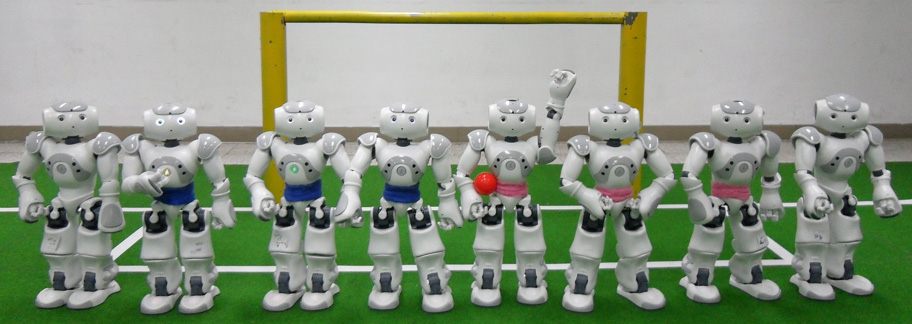
- Dept of Computer Science and Information Engineering
The faculty members of our department are very active in international organizations and play roles as program committee members and session chairs in many important conferences such Annual International Conference on Research in Computational Molecular Biology (ACM RECOMB), IEEE International Conference on Robotics and Automation (ICRA), IEEE Conference on Control Applications (CCA), IEEE Conference on Decision and Control, American Control Conference, IEEE Real-Time Systems Symposium (RTSS), IEEE Real-Time Technology and Embedded Applications Symposium (RTAS), International Conference on Parallel Processing (ICPP), International Symposium on Fault-Tolerant Computing (FTCS), IEEE International Conference on Computer-Aided Design (ICCAD) and IEEE International Conference on Multimedia and Explore. They also won many honors including four IEEE fellows, eight NSC outstanding research awards and three Sinica young researcher awards. In addition, they also work closely with the industry, owning patents and founding companies.
The research of our department can be categorized into four big research groups: "embedded systems", "high performance computing", "bioinformatics", and "Multimedia and Digital Content":
The "embedded systems" group is consisted of Intelligent Robotics and Automation Laboratory, System On Chip Laboratory, Embedding Computing Laboratory, Intelligent Space Laboratory, Low Power VSLI Laboratory, Wireless Network & Mobile Computing Laboratory. The group members are experienced in control and SOC design for industry and very collaborative with the industry. They also won a lot of honors such as IEEE fellows, NSC outstanding research awards and IEEE CSIDC 2003 championship.
Research
- Our scientific interests are driven by the desire to
build intelligent robots, computers and embedded systems, which are capable
of servicing people more efficiently than equivalent manned systems in a
wide variety of dynamic and unstructured environments. We are primarily
driven by the problems of how robots learn about their environment under
uncertainty and with incomplete information. As computers and sensors become
ubiquitous, the importance and need of scene understanding will increase
substantially in the coming decades. Theoretical frameworks as well as
computationally efficient algorithms have to be established and developed at
the intersection of machine perception, machine learning, control,
statistics and optimization. We believe that finding a solution to scene
understanding is a key prerequisite for making robotic systems truly
autonomous and making many potential applications feasible
- Scene Understanding
- Simultaneous Localization, Mapping and Moving Object Tracking (SLAMMOT)
[IJRR'07]
- Stereo-based SLAMMOT [iros'10]
- Monocular SLAMMOT [icra'11]
- Interacting Object Tracking [icra'07][arso'08]
- Simultaneous Ego-motion estimation, Segmentation and Moving Object Detection [icra'09][icra'10]
- Localization in Dynamic Environments [icra'11]
- Data Annotation and Ground Truth [IJRR'11]
- Laser Scanner Failure [icra'08][TMECH'11]
- 3D Object Recognition
- Activity Recognition
- Simultaneous Localization, Mapping and Moving Object Tracking (SLAMMOT)
[IJRR'07]
- Human Understanding
- Hand Posture Recognition [LNCIS'08][aim'09]
3D Face Alignment [iros'08]
- Hand Posture Recognition [LNCIS'08][aim'09]
- Auditory Perception
- Probabilistic Structure from Sound [arso'08][icra'09][AR'09]
- Imitation and Social Learning
- TBA
- Obstacle Avoidance and Planning
- [sircon'09] [TIM'11]
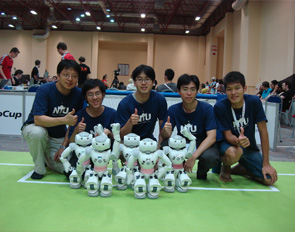
- RoboCup Standard Platform League
- Team NTU Robot PAL
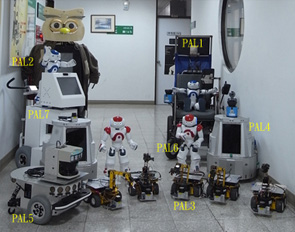
- Robots
- PAL1 and PAL2 [at'09]
- Scene Understanding
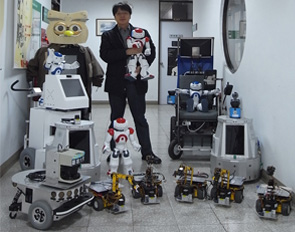
Robot Perception and Learning Lab
-
Robot Perception and Learning
- Object, Activity and Interaction Recognition
- Interacting Object Tracking
- Hand Posture Recognition
- 3-D Face Modeling and Recognition
- GPS-based Activity Recognition
- Human-Robot Interaction
- Machine Perception and Learning of Complex Social Networks
- Mobile Robotic Platform Development
- The Projector-Camera Systems
- Microphone and Camera Array
- Robotic Devices for Rehabilitation
Localization, mapping and moving object tracking serve as the basis for scene understanding, which is a key prerequisite for making a robot truly autonomous. Simultaneous localization, mapping and moving object tracking (SLAMMOT) involves not only simultaneous localization and mapping (SLAM) in dynamic environments but also detecting and tracking these dynamic objects. It is believed by many that a solution to the SLAM problem would open up a vast range of potential applications for autonomous robots. Accordingly, a solution to the SLAMMOT problem would expand robotic applications in proximity to human beings where robots work not only for people but also with people. Current sub-project:- Unification of SLAM and Multi-Target Tracking
- Visual SLAMMOT
- Object, Activity and Interaction Recognition
Research Groups
- The "high performance computing" group focuses on the design and
analysis of algorithms. The research topics include parallel and
distribution computation, scientistic computation and optimization.
Applications include wireless communication, finance computation,
computational physics and data mining. The members of this group have
published papers in top journals and conferences such as SIAM Journal on
Computing and Annual ACM Symposium on Theory of Computing (STOC).
The members of the "Bioinformatics" group collaborate with the college of medicine, college of life science and NTU hospital. They are involved in the development of FASTA, a influential pioneer software for sequence analysis. They have achieved a lot in this area. For example, for classification, our faculty have taken a leading role in developing algorithms for SVM (support vector machine) and RBF (radial basis function). Thousands of users all over the world are using their software including LIBSVM and BSVM. They are also involved in many important national research projects for bioinformatics such as "national research program for genomic medicine" and "national program for biotechnology and pharmaceuticals".
The focus of For "Multimedia and Digital Content" research group is related to content science and media engineering. This group collaborates closely with Sinica, EE department, department of library and information science, institute of linguistics, institute of journalism and the department of drama and theatre. The research topics include editing and analysis for multimedia content, language analysis and so on. One member of this group, the communication and multimedia laboratory, is one of the pioneering research groups in multimedia research. For years, this lab has executed research projects worthy of more than 100 million NTD and transferred technology to many companies such as CyberLink and DigiMax.