|
|
|
|
|
|
|
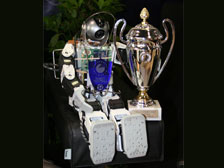
Space Observatory Simulator
Mohsen Saadat, Mir Abbas JalaliSome
engineered systems in outer space remain unreachable even by their designers
and operators. It is therefore important to understand their dynamics and
find a way to simulate them in Earth-based laboratories. Of particular
interest to astronomers is the re-orientation of space observatories in
search of their to-be-observed stars, galaxies, clusters and interstellar
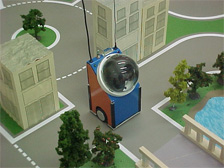
media. In this project, we have designed and prototyped a simulator for
three-dimensional maneuvers of a model observatory. We are using a
combination of angular-momentum-storage wheels and stepper motors to
transfer angular momentum and re-orient a levitated spherical body so that
its vision system smoothly (and continuously) tracks a light source (star).
|
|
|
|
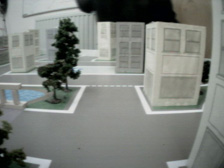
Path of Light Source during the Reorientation Maneuver
|
 |
|
|
|
|
|
 |
|
|
|
|
Simulations of Surface Defects Characterization Using
Force Modulation Atomic Force Microscopy
Hossein Nejat Pishkenari and Ali Meghdari
Abstract:
Using FFM-AFM, characterization of sample defects by a recently developed
gold coated AFM probe in air is investigated. In this research, an online
imaging simulation of the probe and surface is performed, and the effects of
the horizontal scan speed, and effective frequency set-point on the
resulting images are illustrated. The excitation force amplitude adjustment
based on the value of the effective oscillation frequency was made through a
PID controller. The research results are beneficial in providing data on the
mechanisms of sample damage and also on the relative stiffness of the
different surface regions.
|
| |
|
View of the model used in the construction of the
tip-sample interaction force
|
 |
The topography difference of the simulated Ag sample
(with vacancy, Cu and Pb atoms) and a pure Ag sample
|
|
| |
|
The effect of scan speed on the topography
|
| |
|
The effect of set-point frequency on the topography
|
|
|
|
A Dynamic Object Manipulation Approach to Dynamic Biped
Locomotion
Borhan Beigzadeh, Ali Meghdari (Advisor) and
Majid Nili Ahmadabadi (Co-advisor, University of
Tehran )
Abstract:
In this study, we aim at an integrated approach
to Dynamic Biped Walking (DBW) and Dynamic Object Manipulation (DOM) at an
abstract level. To this end, we offer a unified and abstract concept with a
dual interpretation as a DOM and as a DBW system. We validate the proposed
approach by using a set of simulations on an illustrative case study and
show how it can be used in modeling as well as design of planning and
control algorithms for DOM and DBW systems.
In the case study, we describe the proposed
approach and show its dual interpretation by identifying the relations
between 2D dynamic object manipulation of a disc using two planar
manipulators and 2D dynamic object locomotion of lower part of a biped
robot. More specifically, having obtained the equations of DOM, we change
the boundary conditions of the problem in such a way that both radius and
mass of the disc tend to infinity. Simultaneously, both size and mass of the
manipulators' base, i.e. the planet earth, tend to some values in the order
of human's body mass and dimension. Regarding these changes, we can
transform DOM into DBW and vice versa.
To test the proposed approach, a simple control
strategy is introduced to handle impact between the manipulators (legs) and
the object (the earth). In addition, a motion planning system is designed in
such a way that the manipulators (legs) catch and throw the manipulated
object (the earth) in appropriate configurations.
In the simulations, we first simulate the manipulation of a disc both in the
presence of disturbance and without any disturbance. Having obtained
acceptable results, we then simulate the dynamic walking process. The biped
robot is dropped on the ground from the height of 1.25 meter with the
initial horizontal velocity of 2 meter per second. The robot finally reaches
a semi-steady state of running. It can be observed that the robot's running
style is not perfect which was expected as we have put no effort in
optimization of the trajectory and the control parameters in this phase of
our research. Also the robot cannot tolerate big disturbances ([-350N,
350N]) and falls. See figures below.
|
| |
|
Manipulation and locomotion from an absolute point of view
|
| |
|
Planar motion of the disc center | system without
disturbance
|
 |
FIG.7: Planar motion of the disc center | system with
disturbance
|
|
| |
|
Snapshots from one cycle of biped running | system
without disturbance
|
 |
Some Snapshots of the robot falling because of large
disturbance
|
|
|
|
|
CEDRA Rescue Robot
Ali Meghdari, Hanif Mahboobi, Hossein Nejat Pishkenari, Saeid Bagheri, Amir Lotfi, Reza Karimi, Yaser Khalighi, Ali Baghani, Farshid Amiri
Abstract:
Intelligent mobile robots and cooperative multi-agent robotic systems can be
very efficient tools to speed up search and rescue operations. Rescue robots
are also useful to do rescuing jobs in situations that are hazardous for
human rescuers. They can enter gaps and move trough small holes that are
impossible for humans and even trained dogs. Robots should explore in
collapsed structure, extract the map, search for victims and report the
location of victims in map and the way that rescue team can reach him/her.
It can also place a small package containing food, drugs and a communication
device near the victim.
So the rescue robots for reaching to the above goals should have the
following features and capabilities:
- autonomously navigate through collapsed structures
- find victims and ascertain their condition
- produce practical maps of their locations
- deliver real-time communications
- identify hazards
The CEDRA rescue robot has shown it's capabilities in international
arenas. It achieved second place in international Robocop competition (in
real rescue league) which was held in Padua, Italy. All team members are top
and elite students from different departments of Sharif University of
Technology (Mechanical, Electrical and Computer Engineering).
|
| |
|
CEDRA Rescue Robot
|
 |
CEDRA Rescue Robot
|
|
| |
|
CEDRA Rescue Robot
|
 |
CEDRA Rescue Robot
|
|
|
|
|
Molecular Dynamics Assisted Simulation of Nanoscale
Effects in Nanomanipulation
Hanif Mahboobi and Ali Meghdari
Abstract:
Nanomanipulation as a new emerging area enables one to precisely change,
interact and control the nano-scale phenomena. A main consideration of
nanomanipulation is that surface attraction forces are greater than
gravitational forces at nanoscale. In other words, surface area properties
dominate over volume properties. Currently, the modeling schemes are based
on continuum mechanics approaches. Especially at the nano-scale (i.e.
manipulation of fine nanoparticles with size of about 5nm) the physical and
chemical phenomena have not been completely understood. Thus, the aim of
this research is to conduct an atomistic investigation of physical
interaction analysis of the manipulation tool (e.g. STM tip), and nano-scale
objects for manipulation and positioning tasks. To perform this research
Nose-Hoover dynamics and Sutton-Chen interatomic potential will be used to
investigate the behavior of tip-particle-substrate system which is made from
different transient metals.
Expected Results and General Achievements:
- Atomistic simulation of nanoscale interactions in
tip-particle-substrate system as a framework for MD modeling of
nanomanipulation
- Better understanding of stick-slip, sliding and rolling behavior of
the tip-particle-substrate system and their emergence condition
- Better understanding of adhesion phenomenon in the
tip-particle-substrate system and its feasibility as a nanomanipulation
process (including the release approach)
- Determining the tip and substrate materials' type effects on the
success of manipulation process
- Better understanding of the effects of surface roughness, vacancies
and lubricants on nanomanipulation.
- Improvements of nanomanipulation algorithms for ultra fine
nanoparticles
|
| |
|
Simulation of Nanoscale Effects in Nanomanipulation
|
 |
|
|
|
|
|
Dynamic Analysis of a Lower Extremity Exoskeletal System
to Assist Paraplegic Motion
Ali Selk Ghafari, Ali Meghdari and Gholam
Reza Vosoughi
Abstract:
This research seeks to develop an integrated
research and virtual based framework for biomechanical analysis of a robotic
exoskeletal system to assist paraplegic motion.
The four main objectives are to...
- ...develop and evaluate a lower extremity musculoskeletal system
containing eighteen musculo-tendon actuators per leg to provide
biomechanical analysis of human daily activities
- ...design an exoskeletal system actuations based on biomechanical
analysis of muscle functions
- ...develop a dynamical model of the exoskeletal-musculoskeletal
system to provide a simulation framework for biomechanical analysis of
the augmentation system, and...
- ...employing a paraplegic patient conditions to simulate the
movement. The proposed model is valuable for developing and testing
hypotheses that would be impossible to test experimentally or improve
our understanding of the human-machine interactions. The musculoskeletal
model developed in this study is illustrated in figure below.
|
| |
|
The musculoskeletal model
|
 |
|
|
| |
|
Robolens: A Clinical Surgery Assistant Robot
Alireza Mirbagheri,Farzam Farahmand and Ali
Meghdari
Abstract:
Laparoscopic surgery is a specific branch of
Minimally Invasive Surgery (MIS) that is performed in the abdominal cavity.
In this method "ROBOLENS" helps the surgeon by holding and moving the
laparoscopic lens (camera) under his/her supervision during the surgical
operation and acquires a stable view from the surgical site.
It can be controlled by Voice commands or by a
smart foot switch system.
The project is accomplished and the robot has passed technical and clinical
tests at the Imam Khomeini Hospital Complex, Tehran, Iran.
|
| |
|
Robolens at the Imam Khomeini Hospital Complex
|
| |
|
|
| |
|
Design and Evaluation
of a Novel Triaxial Isometric Trunk Muscle Strength Measurement System
Mahmood Reza Azghani, Farzam Farahmand and Ali
Meghdari
Abstract:
Maximal strength measurements of the trunk have been used to evaluate
maximum functional capacity of muscles and the potential mechanical
overload/overuse of the lumbar spine tissues in order to estimate the risk
of developing musculoskeletal injuries. A new triaxial isometric trunk
strength measurement system was designed and developed in the present study
and its reliability and performance was investigated. The system consisted
of three main revolute joints, equipped with torque sensors, which intersect
at L5-S1 and adjustment facilities to fit the body anthropometry and
accommodate both symmetric and asymmetric postures in both seated and
standing positions. The dynamics of the system was formulated to validly
resolve the moment generated by trunk muscles in the three anatomic planes.
The optimal gain and offset of the system were obtained using dead weights
based on the least square linear regression analysis. The R-square results
of calibration for all loading courses of all joints were higher than 0.99
which indicated an excellent linear correlation. The results of the
validation analysis of the regression model suggested that the mean absolute
error and the root mean square error were less than 2% of the applied load.
The maximum value of the minimum detectable change was obtained to be 1.63
Nm for sagittal plane torque measurement, 0.8% of the full scale load. The
trial-to-trial variability analysis of the device using dead weights
provided intraclass correlation coefficients of higher than 0.99, suggesting
an excellent reliability. The cross-talk analysis of the device indicated
maximum cross talks of 1.7% and 3.4% when the system was subjected to
flexion/extension and lateral bending torques, respectively. The trial to
trial variability of the system during in-vivo strength measurement tests
resulted in good to excellent reliability, with intra-class correlation
coefficients ranging from 0.69 to 0.91. The results of the maximum voluntary
isometric torques exertion measurements for 30 subjects indicated a good
agreement with the previously published data in the literature.
|
| |
|
|
| |
|
|
| |
|
|
| |
|
Sharif CEDRA Humanoid
Robot
Ali Meghdari,
Saeed Sohrabpour, Hossein Tamddoni, Farid Jafari, Ali Nezamoddini
Abstract:
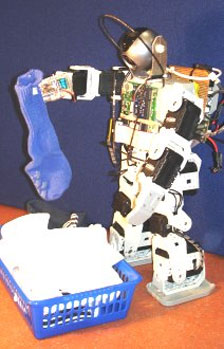
In this project a humanoid robot was designed which could dynamically
walk. Furthermore, It had the ability to play football (detect and kick a
ball). To synthesize a kicking pattern, various objectives such as retaining
its balance even after the kick is done and reducing the undesired angular
momentum using both hands and torso were considered. This kick pattern was
designed so that a desirable ball velocity was achieved. Also the law of
conservation of angular momentum was used to generate a less energy
consuming trajectory.
|
| |
|
|
| |
|
|
 |
|
 |
|
|
|
|
CEDRA ROV
Principal investigators: G.R. Vossoughi, S. Bagheri
Shouraki, A. Alasti
Research Group: H. Borhan, M.H. Saghafi, H. Fiouz, S.Baiyat, H. Khasteh, B.
Taheri
Abstract:
Nowadays underwater ROVs are vastly used in activities, ranging from
underwater monitoring and inspection to installation and repair. In many
inspection and monitoring operations high and accurate maneuvering
capabilities are required.
Researching activities on the underwater ROVs at the center of Excellence in
Design, Robotics and Automation of Sharif university of Tech. was initiated
based on a grant from hi-tech industries center in 2005. The aim of this
grant was the design and prototyping of an underwater ROV for inspection
with accurate maneuvering capabilities for a depth of operation of 300 meter
and a with a payload capability of 10 kg. This ROV is equipped with one
thruster for depth control and 4 thrusters for the horizon maneuvers. The
thrust-to-weight ratio in the horizontal plane is nearly 0.5. One of the
issues in the accurate maneuvering of ROVs is robustness to uncertainties
associated with the varying payloads and hydrodynamics behavior of the
vehicle and the umbilical. Robust Control algorithms using sliding mode
control and adaptive back stepping have been proposed and implemented. More
recently a control algorithm for moving this vehicle has been designed which
enable it to autonomously track a moving target using visual servoing.
|
| |
|
|
|
|
|
CEDRA Climbing Robot
Principal investigators: S. Bagheri Shouraki, G.R.
Vossoughi
Research Group: M.R. Zakerzadeh, M. Tavakkoli
Abstract:
Climbing robots have received much attention in recent years due to
their potential applications in the construction and tall building
maintenance, agricultural harvesting, highways and bridge maintenance,
shipyard production facilities�etc. Research on pole climbing robots at
Sharif University of Technology was initiated based on a grant from Tavanir
Electric Research Center in 2003. The aim of this grant was the design and
prototyping of a robot capable of maintaining the lighting system in the
streets and highways. To this end conception, design, modeling, and
prototyping of a multi-task pole climbing/manipulating robot capable of
traveling along the lighting poles was initiated. The proposed hybrid
manipulator consisted of a one-DOF serial mechanism and a 3-DOF planar 3-RPR
parallel mechanism. This combination provides 2 translational and 2
rotational degrees of freedom for the pole climbing robot. This architecture
provides a good solution for a pole climbing and manipulating robot which
can travel along tubular structures with bends, branches and step changes in
cross section. It is also able to perform manipulation, repair and
maintenance tasks after reaching the target point on the structure. The
proposed robots was built and successfully put to test in September 2005.
|
| |
|
Ball and Plate
Mohsen Saadat, Milad Moarref
Abstract:
The Ball and plate system is a generalization of the famous Ball and
Beam benchmark. The latter is a two Degree of Freedom system consisting of a
ball that can roll on a rigid beam, while the former is a four DOF system
consisting of a ball that can roll freely on a rigid plate. The ball and
plate system is an appropriate device for studying and educating modern
control strategies at graduate level.
The main characteristic of our ball and plate system is the novelty of its
spatial parallel mechanism, which allows the plate to rotate about two
perpendicular axes while maintaining a fixed point at the center of the
plain. Moreover, both actuators are located on the base and thus minimize
the inertia of the device. Other advantages of our mechanism are its high
stiffness and negligible backlash.
The ball's position is feedbacked by a commercial web-camera. The camera
(not visible in the video) is located about 80 cm above the surface of the
plate. A data acquisition card is used for transmitting signals between the
central computer and sensors/actuators.
A fuzzy gain scheduling PID controller is used for the experiments
demonstrated in the video. The gains are tuned to work under large initial
errors, i.e., when the ball bounces on the plate, and when both the position
and velocity errors are very large. In the tracking experiment, the radius
of the desired circle is 10 cm, the tracking velocity is about 9 centimeters
per second, and the average tracking error is less than 1 cm.
|
| |
|
|
| |
|
|
| |
|
|
| |
|
|
| |
|
Haptic Device Application in Virtual Persian Handwriting Training
Misagh Mansouri Boroujeni, Ali Meghdari
Abstract:
Haptic Interfaces have been used as cooperative systems to reproduce
and simulate human actions. The Haptic Interface (HI) can be used as a tool
capable of interacting dynamically with the operator using haptic
technology. By controlling the haptic interface and constraining it to move
through the desired trajectory which is required for most of the training
systems such as Hand Writing Learning System, Minimally Invasive Surgical
Simulation, virtual welding training and gaming applications the users can
easily interact with virtual environment through the sense of touch. Haptic
device application in virtual Persian handwriting training was investigated
in our Robotic Lab (CEDRA) in Sharif University of Technology. Two different
modes of learning were chosen in terms of haptic learning system: full
guidance and partial guidance. In full guidance the haptic device guides the
user to follow recorded trajectory; whereas in partial guidance, a user can
freely follow a pre-written path, but if the user deviates significantly,
the forces automatically brings him/her back to the optimal displayed path.
This system acts in a similar way as a teacher or instructor holding his
trainee�s hand. In the first phase of this project after some introductions,
partial guidance for virtual handwriting learning system was investigated,
for the next phase of this project the trajectory playback using suitable
PID and Neural Network controllers were used. Experimental results from the
generated softwares also justify the practical methodology which was
proposed for virtual handwriting training. The results from the both stages
of learning reveal that this method can be useful alphabet learning tool for
not only the novice student in the first years of primary school but also as
a powerful tool for more advanced training, handicapped and blind people as
well.
|
| |
|
|
| |
|
|
| |
|
|
| |
|
|
|
|
Automatic Control Laboratory
Automatic Control Lab in Department of Mechanical
Engineering has two main sections: Training Lab and Project Lab.
Training Lab:
In Training section a one unit credit course is offered for undergraduate
senior students.Following experiment sets are available for design and
analysis of control systems:
- Thermal System Control
- Process Control Simulator
- DC Motor position and speed
- Control set up
- PID fault detection unit
- Liquid Level Control
- Fluid flow control set up
- Pneumatic and Hydraulic control system kit
Project Lab: In project Lab section, undergraduate and graduate
students produce their own experiment set up. The produced test beds are
mostly used in design and analysis of advanced control systems. Some of
projects performed in this lab are:
- Twin Propeller System: Which
is a coupled, 2 DOF, MIMO, nonlinear system with a considerable
uncertainty in the input channels.
MIMO Sliding Mode control and
nonlinear QFT controls have been applied to this system.
- Vertical Wind Tunnel:
Fuzzy height control of a variable
shape object in a vertical tunnel has been applied to this set up.
- 2 DOF x-y Inverted Pendulum
- Experimental Prototype of Anti-Sway Gantry Crane Control System
- 4-Legged Walking Robot
- Training Prototype of a Rotary Vector (RV) Speed Reduction System
|
 |
Mechatronics Laboratory
Mechatronics is the synergistic integration of mechanical
engineering with electronics and intelligent computer control in the design
and manufacture of products and processes. It is a relatively new concept
relating to the design of systems, devices, and products aimed at achieving
an optimal balance between basic mechanical structure and its overall
control.
Research and education at the Mechatronics lab help students gain a better
understanding of the principals of electronics and to give them experience
with instruments and methods used by technicians and electronic engineers.
This lab provides the opportunity for the Mechanical Engineering students to
experience working with electronic components and circuits and learn about
their integration into microprocessor based electro-mechanical systems. FPGA
programming, electronic instrumentation, computer (PC and Micro-controller
based) interfacing and real-time control are some of the principles, which
the students working in this lab are exposed to.
|
 |
Manufacturing and Measurement Laboratory
The CAD/CAE/CAM part of the lab is equipped with a CNC �
3axis milling machine. Some powerful computers provide the students various
softwares for modeling of deformation processes as well as cad-cam
simulations. A 30-ton hydraulic press provides the opportunity to exercise
the physical modeling of metal-forming processes.
Recent research activities:
- Physical modeling of extrusion process
- Determination of load and strain-stress in closed die forging using
the Plasticine Technique.
- Improvement of vibrational characteristics of auto motive parts by
using epoxy fiberglass composites.
- The influence of material properties on the shape and level of the
forming limit diagrams.
|
|
|
|
Robotics Instructional Laboratory
This laboratory is developed for instruction of robotics
science and technology to undergraduate and graduate students. Laboratory
facilities include two articulated 6 D.O.F and 5 D.O.F robot manipulators,
vision systems, digital cameras, and various robotic projects designed and
fabricated by students.
|
 |
Robotics Research Laboratory
This laboratory is equipped with a number of powerful
personal computers running under Windows. All PCs are connected in a local
network, and have access to the Internet. A number of major engineering
software necessary for mechanical modeling, simulation, and analysis have
been installed on these computers.
Some researches which have been done are:
- Kinematics /kinetics modeling and analysis of the human knee joints.
- Force and impedance control of flexible robotics arms.
- Modeling and simulation of jumping process of a two-legged robot.
- Modeling and identification of an underwater vehicle equipped with a
manipulator arm.
- Stability analysis of mobile manipulators.
- Design and fabrication of control system for an underwater ROV
equipped with two D.O.F. manipulator.
- Design and fabrication of a master/slave manipulator.
- Visual servo control of a robotic arm in an underwater ROV.
- Attitude control of micro-satellites.
|
 |
Project Workshop
Project workshop is a facility that supports the
undergraduate engineering curriculum. This facility is a start-to-finish
project center with various electro-mechanical devices and equipments that
enables students to take their projects from the initial "idea stage" to the
"final product and presentation stage". Students are trained to work in a
team in order to complete their projects. Upon finalizing their design
plans, the students apply their CAD skills to their project design on
state-of-the-art PC�s. Once their design is complete, they use the machine
shop to build a scaled model or prototype to test their design. CEDRA
believes that it is important for the engineering students to be able to
develop intuitive, practical skills through hands-on testing, and gain a
feel for practical applications of their ideas. After fabricating and
testing their prototypes, students can create their own computer and video
presentations, or "burn" their own CD ROMs.
|
|
|
|
Machine Shop
This is a shop dedicated to student use for fabricating
design project components. The shop includes a variety of light machining
equipment, hand tools, stock materials and hardware.
The facility is used for fabricating of mechanical parts to be used in
various research projects.
|
 |
Creativity in Design Laboratory
This is a unique facility intended to stimulate and help
in growth of students� creative design ideas. The lab is used both for
design courses and design competitions in undergraduate and graduate levels.
The basic lab tools enable the students in realizing their creative ideas in
the form of mockups or prototypes. Instructors help students in developing
the ideas and also in choosing a proper fabrication method for their
machines. The lab has equipments and bench space for 36 students at one
time. It has hand and power tools for cutting, shaping, joining of simple
work materials, as well as assembling them into the form of simple machines.
The lab is also providing a number of working desks for graduate students
working on automation projects.
|
 |
BioRobotics Laboratory
No Description
|
|
|
|
|
|
| Navigation |
 |
|
 |
| Activities |
Welcome to the Center of Excellence in Design, Robotics,
and Automation (CEDRA).
CEDRA is the premier applied research, education and technology center in
IRAN.
The main goal of this group is to develop the relationship between university
and industry and it tries to fill the existent gap between them. Therefore the
main activity of this team has been focused on researches about designing and
manufacturing of industrial grade rescue robots.
|
|
|
|
|