
- Offer Profile
- WMG is an academic department of the University of Warwick and was established by Professor Lord Kumar Bhattacharyya in 1980 in order to reinvigorate UK manufacturing through the application of cutting edge research and effective knowledge transfer. The group started small - just an office, the Professor and his secretary - but has since grown into a global force to be reckoned with, delving outside its manufacturing core into new sectors: health, banking, the built environment and digital technology to name a few.
Automation & robotics
- Pharmaceuticals
A WMG team, led by robotics expert Professor Ken Young, has created robotic systems for improving the development of new drugs for pharmaceutical giant GlaxoSmithKline.
Prof Young explains: “Developing new drugs is a long, and quite boring, process. There is a massive amount of repetitive tasks that need to be done such as weighing compounds for a new drug.
“Traditionally these are done by PhD students working for the big companies like GSK. Our system not only removes the need for people – who get bored and make mistakes – it dramatically improves the reliability and repeatability.
“In order to get new drugs right, companies have to try thousands of different variants of compounds. Once the right combination is found, it can be quite hard to repeat it precisely.
“By using robots to do these repetitive tasks, drug companies can be absolutely certain of the ingredients and amounts required to repeat a successful compound.”
A further development is to use flow synthesis to increase the speed of development: a technique borrowed from WMG’s manufacturing expertise. The technique means that the method of development is close to the method used in full production, just on a smaller scale.
Developing a new drug from scratch can take as long as 15 years, but Prof Young’s system should speed that up meaning patients get the drugs they need to beat today’s illnesses much more quickly.
Automotive
A technique developed by Prof Young for spot welding aluminium could make cars leaner and greener.
Although some cars already have a shell made from aluminium, the metal sheets have to be riveted together with steel rivets – around 3,000 of them. Not only is this costly it also makes recycling an aluminium car more difficult as the two metals have to be separated. Using steel also adds to the weight of the car, detracting from the lightweight properties of aluminium.
Prof Young has developed a pioneering way, using robot arms, to spot weld aluminium sheets together using copper electrodes.
This process, developed with Jaguar and Land Rover is only two years away from full production and could mean that all cars are made from aluminium in the future.
Prof Young explains: “Aluminium is the most plentifully available metal in the world. Although it seems expensive, it is very strong so you can use less of it to build a car.
“Improving the process for joining aluminium together means that more cars will be made from it in the future meaning lighter cars that use less fuel and are more easily recycled.”
Lawnmowers
Prof Young’s team is investigating ways to automate lawnmowers so that parks and golf courses can be kept looking their best without interrupting enjoyment of our open spaces.
Using a wide range of sensors including GPS, vision systems, radars and odometry, Prof Young hopes to create a fully automated grass cutter.
This work is in collaboration with Ransomes Jacobsen, the global turf equipment manufacturer.
Mushroom Picker
There's a new sound down at Old MacDonald's farm, where the cacophony of noise is being replaced by the soft hiss of hydraulics and the faint hum of electricity.
At the University of Warwick, proudly situated in the West Midlands, at the heart of the UK, scientists in the Warwick Manufacturing Group are working on a number of robotic and automation projects that could change the face of modern farming.
Mushrooms are a delicate crop that has to be reared under conditions that are less than pleasant for human workers to operate in. Now a robot mushroom picker can identify mushrooms at their optimum picking size; needing little space or light to work in, ideal conditions for growing mushrooms, it can work around the clock, maximizing the use of peak picking opportunities.
Researchers at Warwick have also replaced the remote control unit of the “Ransomes Spider” grass cutter with an even more remote unit – a computer that will programme and control groups of cutters to take the hard work out of mowing large areas of grassland.
Teaming up with scientists at Warwick HRI, the University’s Agricultural arm, the Warwick Manufacturing Group have also developed an inflatable conveyor belt for agricultural machinery company “Aeropick” - a compact and easily maneuverable system that can be taken into the field to speed crops to storage, ensuring the very best quality and maximizing crop profits.
The robotic revolution is all about working smarter, not harder – something that should come as a welcome change to a profession with more than its fair share of drudgery.
Old MacDonald will still have his farm but it promises to be a quieter, more efficient farm for the future.
Agricultural Robot to Identify Weeds in Pastureland
Synopsis
This project involves the development of an autonomous grass cutting mobile robot through the use of a wide range of sensor equipment.
Aims
To develop sensor fusion technologies that enable an industrial lawn mower to behave autonomously and perform a range of grassland management roles. This will include combining data from GPS, wheel encoders, short and medium range radars, ultrasonic sensors etc. and creating a range of filtration models with error maps to best estimate the true position of the mower and objects in its vicinity. This will then be used as a platform for task level programs to control the mower through its desired behaviour.
Expected Outcomes
The eventual outcome of this research is expected to be an autonomous mobile robotics platform which uses sensor fusion to carry out a particular task.
Benefits
If successful this technology can be implemented by all grassland management machinery manufacturers and agricultural machinery manufacturers. It will be used for all kinds of pasture management, golf courses, public parks, cemeteries etc. It could also be used for on road vehicles such as cars, trucks, buses etc. and so could affect the lives of the whole population.
Laser Treatment Transforms MDF Producing Startling Image of Rare Wood Grains
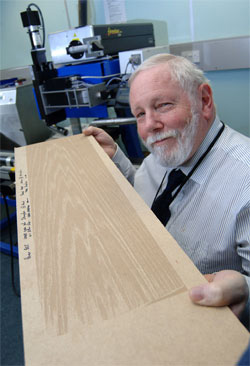
Researchers at WMG at the University of Warwick have devised a way of using a laser that transforms MDF giving it a surface finish that looks like some of the most expensive wood grains.
The “LaserCoat” research project in a collaborative research effort consisting of eight academic, research and commercial organisations and part-financed by the Technology Strategy Board.
University of Warwick WMG researcher Dr Ken Young said:
“MDF is a superb and highly versatile material. It’s easy to work with and cheap. It is usually made from waste material so it is much kinder to the environment than using more real wood. But normally it looks rather dull in its raw state. Until now there has been no way to liven it up other than painting it.”
“Using lasers to produce a wood grain in MDF could help bring a more natural quality into homes and businesses without the financial and environmental cost of having to use new wood.”
The technology also has great potential for commercial use as it is very hardwearing and can be used for flooring or other applications where cost is an issue but where looks are important too. It can mimic a vast range of real wood grains, it can produce logos, decoration, or even coloured and shaped decorative surfaces using a powder coating version of this new laser technology.
Mick Toner, Factory Manager of Howarth Windows & Doors sees significant benefits from the new technology for his business
“We would love to use MDF for the glazing beads in doubling glazing but customers do not like the look of raw MDF. This LaserCoat technology will provide a grained look that will delight our customers, give us much more manufacturing flexibility and cut the cost of the raw materials four fold”
“MDF is also an ideal material for providing the thermal insulation required for modern doors. Our customers are increasing using translucent coatings on their doors which are not aesthetically pleasing on MDF panels – the LaserCoat technology cuts through this problem providing an attractive surface for MDF no matter the coating used”
- Pharmaceuticals
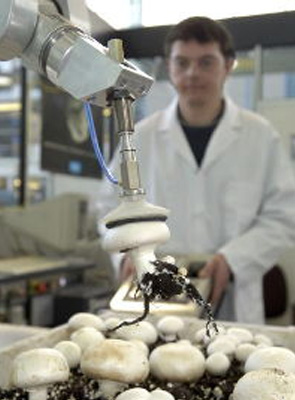
Mushroom picker
- Jim Rowley, an engineering doctorate student with WMG, is
developing a robotic solution which mimics the action of a human mushroom
picker and has the potential to revolutionise an industry in crisis. The
robotic system is being built at WMG’s International Manufacturing Centre
and is supported with sponsorship from the Horticultural Development
Council.
Labour costs associated with hand-picking plus ineffiencies in the system mean Britain’s mushroom farms are no longer as competitive as their European counterparts.
Jim explains: “The UK mushroom industry is facing immense pressure from Poland, Holland and Ireland, to name but a few. We're saying that automation could reduce production costs by eliminating the labour associated with harvesting.”
Jim’s doctorate is called Automated Harvesting of Agaricus Bisporus – the typical button, closed and open cup and open flat mushrooms we see in the shops. The robot uses a vision system to select appropriately-sized and healthy mushrooms from trays on which they are grown. The system pinpoints the co-ordinates of each mushroom and sends a message to a robot controller which uses a laser to estimate the mushroom’s height. The picking is done by an arm with three end-effectors, each of which applies a vacuum to a mushroom’s surface and picks and places it in a receptacle.
One of the continuing aims has been to compare the cycle time of the robot with that of a human picker in order to ensure maximum efficiency on a particular farm. After full trials of the completed robot, the challenge will be to present a convincing argument for the technology. Previous attempts at commercial automation have failed but Jim hopes that the appeal of his robot lies in the possibilities for wider application through the horticultural and other industries.
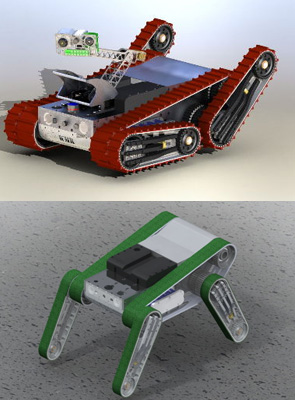
RoboCup: Rescue Challenge
- Competed at USAR, Urban Search And Rescue
April 2008, Hannover Messe, Germany
A dynamic environment simulating a partially collapsed building
Large-scale disaster mitigation of the future
Find a simulated victim (emitting heat and other signs of life: motion, sound and carbon dioxide) and determine state of consciousness
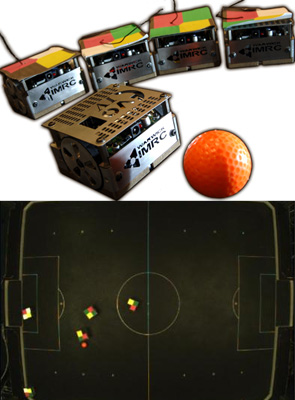
FIRA MiroSot: Robot Football Competition
- Five, 7.5cm square robots
Achievements
- Quarter Finals at 2006 FIRA International Championship (Singapore)
- 1st place 2006 UK MiroSot Simulation Championship
- 2nd place at 2007 UK MiroSot ChampionshipThe Warwick Robot Football is now set-up in the Digital Laboratory
Previous teams have entered the robot football competition known as MiroSot, regulated by the global federation FIRA (Federation of International Robosoccer Association). The aim this competition is to produce a competitive team of FIRA certified robots, 7.5cm square.
MiroSot is an inter-university competition consisting of 5 robots a side, using a computer controlled algorithm to calculate robot positions, based on data from a vision system. Last year we achieved 2nd place at the UK national championships and we are confident we can improve on this result in 2008.
UPDATE: This year we managed to place first at the UK National MiroSot Championships, achieving our original goal.
FIRA MiroSot is the Robot Football competition in which we participate. The concept is fairly simple, to get two teams of robots, with five robots per side, to play game of football completely autonomously. Each robot is limited in size to a maximum of a 7.5cm cube. The ball that the teams play with is an orange golf ball. Above the pitch is a machine vision camera running at 60 frames per second. This camera is linked back to a server which then calculates the positions and velocities of each of the robots and ball, from which it determines what each robot should be doing. These instructions are then communicated to the robots over a wireless link.