- Offer Profile
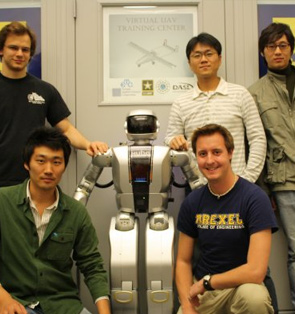
- DASL (Drexel Autonomous Systems Laboratory) is under the direction of Dr. Paul Oh of the Mechanical Engineering and Mechanics Department at Drexel University. Laboratory members consist of students from the freshman level to Ph.D candidates. While under the Mechanical Engineering and Mechanics Department, the lab is truely a multidisciplinary environment with projects and students coming from Electrical and Computer Engineering, Mechanical Engineering, Computer Science, and even Psychology. Current projects range from Unmanned Aerial/Ground Vehicle Applications to Huminoid Robotics.
HUMANOIDS
- "DASL's working mission statement is to conceive,
develop, implement and configure sensor-based solutions
and "smart" mechatronic systems for robotics and human augmented applications." - Paul Y. Oh, Ph.D.
HUBO the Humanoid
- A team of researchers led by Drexel University is
collaborating with a team of Korean researchers on advancing humanoid
development and enhance the concept of human- robotic interaction. The
five-year project, funded through the National Science Foundation (NSF)
Partnership for International Research and Education Program, seeks
transformative models to train scientists and engineers to effectively work
in global multi-disciplined design teams.
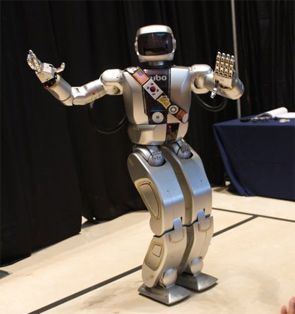
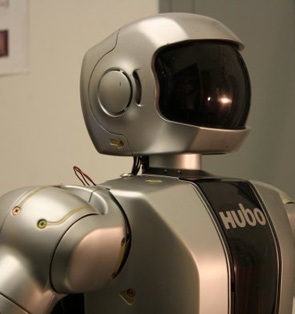
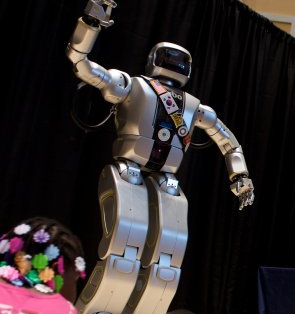
The project’s goal is to enable humanoids to interact with their environment. Through the collaboration, Drexel now houses a version of the Korea Advanced Institute of Science and Technology’s HUBO humanoid, Jaemi HUBO. Researchers at The University of Pennsylvania, Colby College, Bryn Mawr College and Virginia Tech in the United States, and KAIST, Korea University and Seoul National University, are each working to add their own expertise to Jaemi HUBO in order to advance and enhance the humanoid and its interaction with people and environments. Targeted enhancement features include a capability to move over rugged terrain and in unstructured environments and to interact socially with humans and handle objects. Jaemi HUBO will also educate the American public, beginning at a young age about the science of robotics.
“With Japan and Korea aggressively pursuing robotics because the field is one of the top 10 technology areas considered as engines for their economic growth, the U.S. is in danger of losing its leading position,” said Paul Oh, associate professor at Drexel’s College of Engineering and Director of the Drexel Autonomous Systems Lab (DASL).
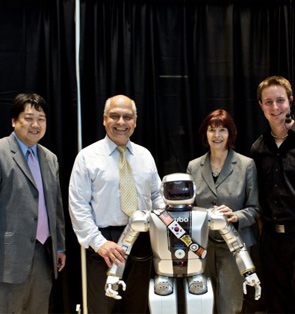
To advance humanoids to the next level, however, there is a need for the capability to navigate and manipulate objects and interact with people in unstructured environments. Such capabilities demand information technologies like cognition, perception and networking, where the U.S. maintains a leading position, according to Oh.Through the five-year collaborative program researchers and Drexel students will travel to Korea and share information. Two Drexel doctoral students Robert Ellenberg and Daniel Lofaro have already been to Korea to work with KAIST and are the primary caretakers of Jaemi HUBO in the autonomous lab.
“Even if support existed for the United States to build its own humanoid, the learning curve and building time would likely yield models that continuously lag behind those from Asia,” said Oh. “The critical gap that prevents a vertical advance in humanoids is the lack of platforms in the U.S. and infrastructure to globally consolidate knowledge and benchmark performance.”
Through the collaborative effort, the researchers of the PIRE team will each provide their expertise to advance the capabilities of Jaemi HUBO. Dan Lee of the University of Pennsylvania will provide his expertise to develop and demonstrate advanced humanoid capabilities that include locomotion over rugged and unstructured terrain. Dennis Hong of Virginia Tech will develop a low-cost mini HUBO for the broader robotics community to apply and test algorithms. Doug Blank of Bryn Mawr College will explore advanced artificial intelligence on robots that will be used to develop software for roboticists to engage in advancing humanoid capabilities.
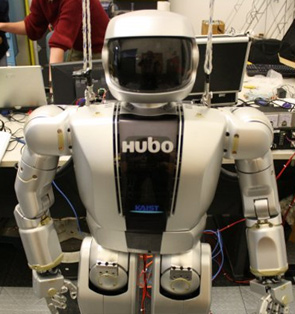
Oh, a leader in systems integration, robotics, sensors and control, has developed an online HUBO or a universally accessible platform for the robotics community. Drexel’s lab has been, and will continue to be used as a test rig. Oh and the Drexel team have procured Jaemi HUBO that can be controlled and monitored online. This is achieved by a gantry that follows HUBO and a tether that prevents the humanoid from catastrophic falls. Should HUBO stumble the tether will prevent the fall and researchers could then re-program the robot.
To educate the American public at all ages, and especially to increase the interest of young children in robotics and humanoid interaction, Jaemi HUBO will be displayed at Please Touch Museum in Philadelphia, and interact with the young children who visit the museum from May 28 to May 30. A demonstration of Jamei HUBO interacting with the children, greeting passersby, and playing “Simon Says” will showcase the humanoid’s capabilities on May 28 at 2 p.m. Subsequent appearances will also be scheduled at various times throughout the year.