AGVs ensure fast deliveries
Hermes tackles time pressures in online retail with automated transport solutions: At the Hermes logistics centre in Löhne, two subsidiaries of the Otto Group handle the delivery of bulky consignments to end consumers. These customers expect their deliveries to arrive as quickly as possible. Mobile robots from Melkus Mechatronic handle the transport to the lorry loading bays via a connecting corridor. This automation step ensures fast deliveries with short handling times and safeguards the logistics providers’ competitiveness.
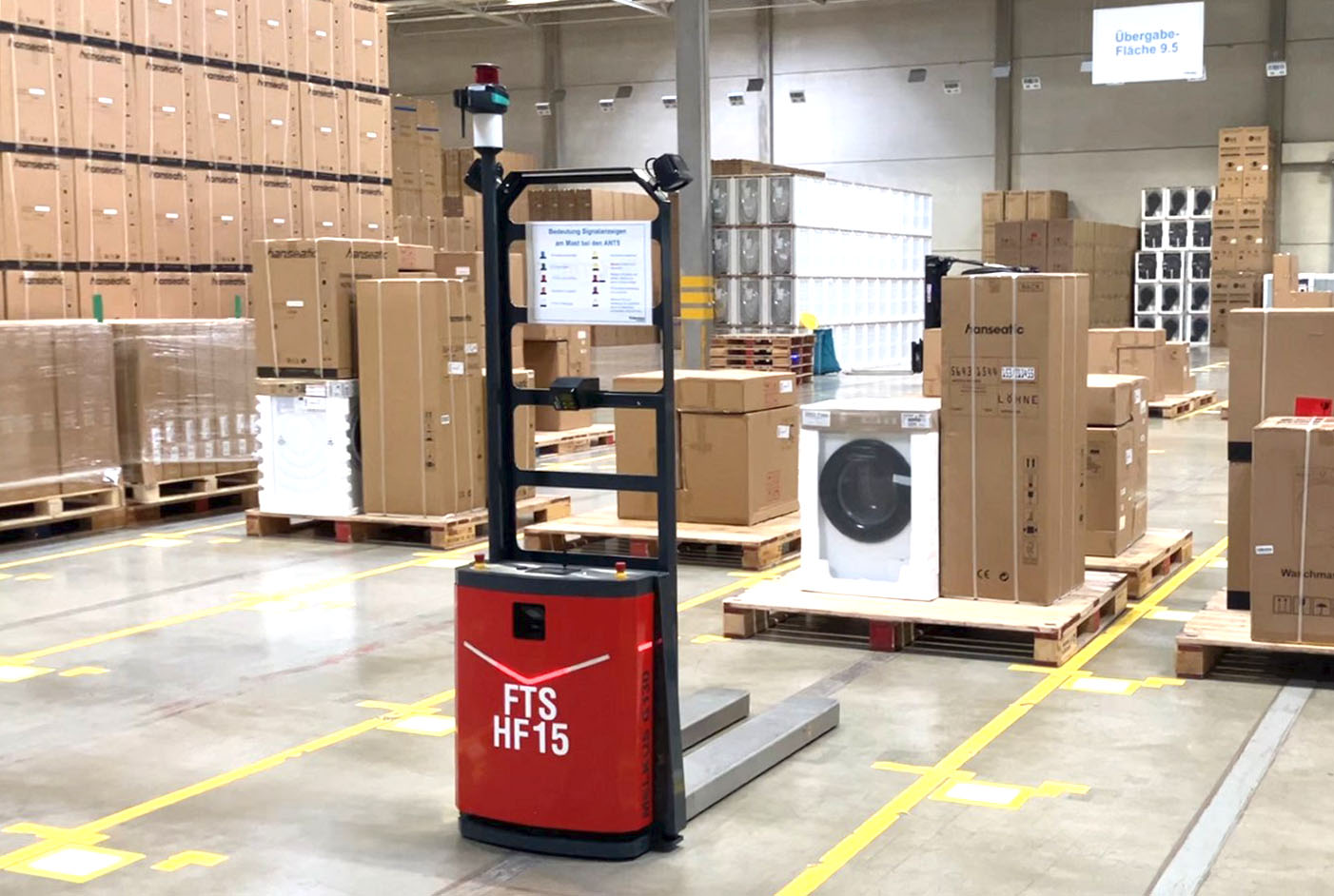
Photo by Hermes
After placing an order via an online catalogue in a matter of minutes, consumers are not prepared to wait weeks for delivery. This expectation has led to stricter demands being placed on logistics.
Large-scale distribution warehouse with a connecting corridor
680 employees, 100,000 m² of warehouse space and 128 lorry loading bays, with more than four million orders processed annually. Hermes Fulfilment (HF) operates a distribution centre and handles returns. Once an order has been received, the picked consignments are transported from the twelve-metre-high wide-aisle high-bay warehouse to the designated lorry bay at the adjacent main transhipment centre (HUB) of Hermes Einrichtungs Service (HES). In the process, consignments travel up to 600 metres.
An automated guided vehicle (AGV) system was to take over internal transport operations and relieve the workforce of heavy, repetitive tasks. The aim was to increase the number of transports per day, reduce throughput times and improve process stability. An objective was to transport 1,000 consignments per day, each with a total weight of up to 1,000 kg. The goods are provided on pallets of various sizes. These must be reliably located and picked up within a tolerance range of 200 mm. The transport routes, which run through two warehouses and a connecting corridor, are used not only by AGVs, but also by forklift trucks and pedestrians. This also demands that the driverless transport vehicles (FTFs) ensure uncompromised personal safety.
Smart automation solution from Melkus Mechatronic
“Given the size and complexity of the overall system, we opted for the experienced Austrian AGV manufacturer Melkus Mechatronic,” explains Marc-Andre Münstermann, logistics planner at Hermes Fulfilment GmbH. To ensure these complex requirements were met reliably, the Hermes companies jointly procured 28 units of the Melkus G130 2.0 pallet AGV. “The Melkus G130 can carry a payload of up to 1,200 kg,” explains Dominik Schnitzinger, Head of Software Development & Customer Support at Melkus Mechatronic. “By positioning itself autonomously in front of the pallet, it picks up the load with extreme precision and speed.”
The vehicle is equipped with an omnidirectional drive system and is therefore capable of moving in any direction; the 360° laser scanners enable it to scan its surroundings and the load, as well as to recognise pallets with precision. This allows the AGV to position itself autonomously in front of the pallet without the manoeuvring that would otherwise be required. The Melkus G130’s sensor system enables SLAM navigation without the need for external aids and ensures reliable protection against collisions with unexpected obstacles – and, above all, with people. The scanners thus guarantee safe and seamless mixed-traffic operations within the logistics centre.
“We see great potential in the Melkus G130 and, above all, hope it will bring greater reliability and punctuality to our processes,” said Hakan Sanal, Supervisor of Warehouse Outbound & Facility Management at Hermes Einrichtungs Service GmbH & Co.KG, expressing his conviction even during the early stages of implementation. After just one year, the AGV fleet at HES was expanded. There are also plans to extend the use of the existing AGVs in the near future. The aim is to automate the return transport of empty pallets as well, in order to enhance the sustainability of the facility.
For more information visit: www.melkus-mechatronic.com
News Categories
- » NEWS HOME
- » Automation & Robotics
- » Industry 4.0
- » Material Handling
- » Sensors
- » Quality & Testing
- » Machine Vision
- » Laser & Optics
- » Metalworking
- » Motion Control & Drives
- » Hydraulics & Pneumatics
- » Process Industry
- » Renewable Energy
- » Agriculture
- » Home & Office Furniture
- » Additive Manufacturing
- » Environmental Tech
Related Expos




Tags
 |
 |
 |
 |
 |
 |
 |
 |
 |
 |
 |
 |
 |
 |
 |
 |
 |
 |
 |
 |
 |
 |
 |
 |
 |
 |
 |