German high-tech technology for the semiconductor industry
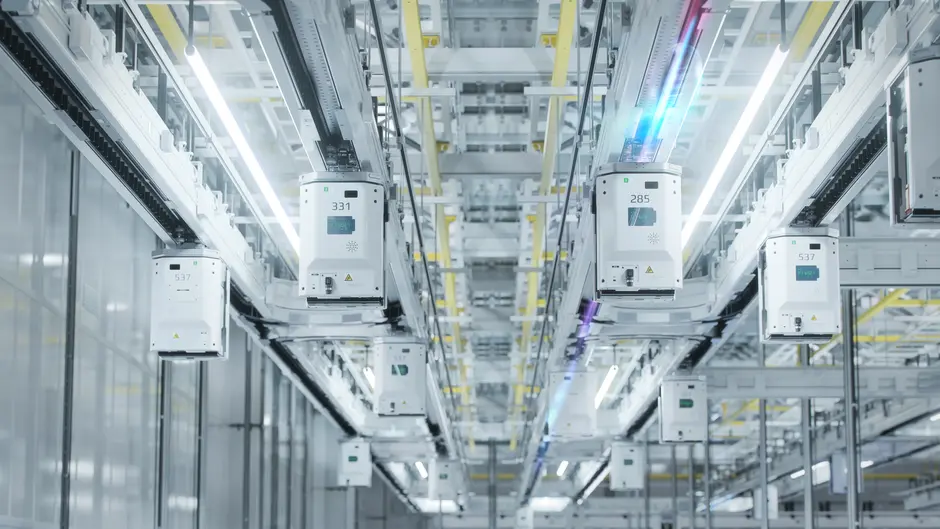
In today’s digital world, nothing works without semiconductors. These tiny components are the backbone of our modern society and characterise our daily lives, from smartphones and electric cars to AI systems. The majority of these key components are manufactured in Taiwan, which accounts for around a quarter of global production. This makes the island in the western Pacific the strategic hotspot of the global technology landscape. Now a German medium-sized company has succeeded in entering this extremely sensitive market: Paul Vahle GmbH & Co. KG has developed an innovative system for contactless energy transmission for Overhead Hoist Transport (OHT) systems. A technology that is proving to be particularly efficient in the high-precision production of semiconductors.
If you want to understand the future of this technology, you have to look to Taiwan. The island state has developed into the control centre of the global semiconductor industry. Above all, Taiwan Semiconductor Manufacturing Company Limited, or TSMC for short, is the world’s largest chip manufacturer. Many German companies also source important electronic components and IT components from Taiwan or have them manufactured there.
Strategic market entry
The market entry of Paul Vahle GmbH & Co KG from the tranquil town of Kamen – a town better known for traffic jams and slow-moving traffic at the Kamen junction – into the Taiwanese chip market is no coincidence, but a strategic response to global changes. And hardly any other place in the world is currently as decisive for the industrial future as the island off the Chinese coast. Steffen Fink, Field Application Engineer at VAHLE, puts it in a nutshell: “If you want to be a player in the semiconductor industry, you have to be present in Taiwan or you will be left behind.”
A large part of the intralogistics in chip production is based on automated transport systems (OHT systems), which move the sensitive semiconductors between the production steps. “This market used to be firmly in Japanese hands, with its own closed energy supply systems,” explains Fink. But the wind has changed: Taiwan’s companies are striving for more independence, innovation and new technologies. This is precisely where VAHLE sees its opportunity. With a product that literally makes the connection possible.
Efficiency and safety in production
Because what the system provider for mobile industrial applications has developed in the field of contactless power transmission is unique in the world: the in-house CPS140 technology (Contactless Power Supply) operates at a transmission frequency of 140 kHz. This is more than seven times the frequency used by other market players. This is because established systems are often still based on technology standards from the 1990s and only use 10 to 20 kHz. “The high frequency also enables a significantly lower current,” explains Fink. While other providers work with up to 85 amps, VAHLE only needs 45 amps. “In direct comparison, our technology is therefore more efficient, four times less lossy and significantly more powerful than many existing solutions.”
Another advantage: CPS140 generates a particularly small magnetic field with an extremely high energy density. This is a decisive advantage in sensitive production environments with high safety requirements. The so-called metal-free zone is also reduced to a minimum. “This means minimal power losses, minimal heating in areas close to metal and therefore greater safety and efficiency in operation,” says Fink. In semiconductor production in particular, every degree counts: production takes place in strictly air-conditioned clean rooms at a constant 25 degrees Celsius and defined humidity. Any unnecessary heating due to power loss must be compensated for in a costly and energy-intensive manner. The VAHLE system therefore not only lowers energy consumption, but also reduces cooling requirements and thus operating costs.
For further information visit: https://www.vahle.com/en/company/news/news/german-high-tech-technology-for-the-semiconductor-industry-1
News Categories
- » NEWS HOME
- » Automation & Robotics
- » Industry 4.0
- » Material Handling
- » Sensors
- » Quality & Testing
- » Machine Vision
- » Laser & Optics
- » Metalworking
- » Motion Control & Drives
- » Hydraulics & Pneumatics
- » Process Industry
- » Renewable Energy
- » Agriculture
- » Home & Office Furniture
- » Additive Manufacturing
- » Environmental Tech
Related Expos




Tags
 |
 |
 |
 |
 |
 |
 |
 |
 |
 |
 |
 |
 |
 |
 |
 |
 |
 |
 |
 |
 |
 |
 |
 |
 |
 |
 |