Weingärtner Maschinenbau Perfects the Turn-Peel Process Using KCU25B Carbide Grade with KENGold PVD Coating Technology
Weingärtner Maschinenbau GmbH, headquartered in Kirchham (Upper Austria), has been one of the leading providers of complete machining solutions for the metal cutting industry for decades. Founded in 1966, the company began as a traditional contract manufacturer and quickly became a pioneer in whirling technology – especially for screw components in the plastics industry.
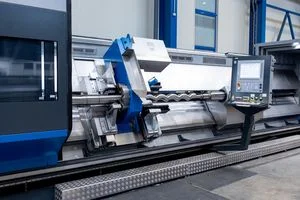
Today, the Weingärtner name stands worldwide for precision, innovation, and customer-specific solutions in the machining of large components. The product range includes mpmc complete machining centers for the high-precision processing of large rotating parts, the compact vario+ series for demanding turning and peeling processes, the pickup 400 specialized in extrusion and injection screws, and the finish series – an all-in-one solution for grinding, polishing, and measuring. “Our machines are particularly in demand in challenging industries such as energy, aerospace, plastics processing, and heavy-duty machining – wherever top precision, flexibility, and productivity are required,” summarizes Daniel Weber, responsible for software and process development.
What distinguishes Weingärtner is its holistic approach: “Instead of standard machines, our customers receive tailored complete solutions – consisting of individual consultation, modular machine design, specially developed CAD/CAM software, application-specific technologies, practical training, and comprehensive global service,” Weber adds.
Reliable Rotor Production Process
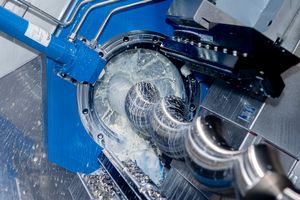
For a customer in the pump industry, Weingärtner is currently producing approximately 60 rotors for progressing cavity pumps on a contract basis. A vario+ 700 machining center from its own portfolio was equipped with a turn-peeling head to fully machine the pre-turned shafts in a single pass. The special feature: although the customer has already purchased the machine, the designated facility is not yet ready. Therefore, Weingärtner is temporarily taking over both the process design and the rotor production in Kirchham.
The material being machined is austenitic, corrosion-resistant stainless steel grade 1.4435, with a diameter of 160 mm and a length of 3,900 mm. During the turn-peeling process, approximately 60 mm in diameter is removed – down to a final diameter of 100.5 mm.
The Turn-Peeling Challenge
Turn-peeling is one of the most demanding metal-cutting processes in heavy-duty machining. It is technically a kinematically reversed longitudinal turning process – using a rotating tool and a continuously fed workpiece. At Weingärtner, the process is similar, although the workpiece is positioned off-center. “The indexable inserts operate in both interrupted and continuous cuts, which places significant stress on the cutting edges,” Weber explains.
A key challenge is that the entire machining must be completed in a single setup – without tool changes. Any tool failure or drop in tool life can damage not only the workpiece but also the peeling head. “We wanted to machine the entire component with a single tool set – no stops, no tool changes, no breakage,” says Weber. The reason is clear: every change would affect the surface finish and cause around 30 minutes of downtime per part – performed manually under difficult access conditions to the tool holder.
The Path to the Solution
Numerous tests with different tool manufacturers initially yielded unsatisfactory results. Most inserts had to be replaced halfway through, and some failed unpredictably – leaving marks on the workpiece and posing a risk of severe damage. The breakthrough came with Kennametal’s KCU25B grade. “We immediately noticed something different – something we hadn’t seen before,” Weber recalls. “The tool life was impressive right from the start, the surface quality was consistent, and chip control was reliable.” Ultimately, 150 minutes of uninterrupted machining per component was achieved – without any insert changes.
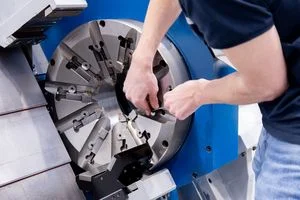
The peeling head used features ten ISO holders, equipped with nine roughing and one finishing indexable inserts from Kennametal. The specific carbide grade is KCU25B – using RP geometry for roughing and MS geometry for finishing. The roughing inserts operate at a depth of cut of ap = 5.5 mm, and the finishing insert at ap = 2.0 mm. “By optimizing the process, we reduced the machining time from 150 to 126 minutes – with consistently excellent results,” says Markus Pleyer, the Kennametal sales engineer overseeing the project.
The Coating Makes the Difference
The key to the new insert grade lies in the innovative KENGold coating, a PVD technology applied to a tough carbide substrate. “This combination delivers outstanding wear resistance and process reliability, particularly for challenging materials and varying cutting conditions,” Pleyer explains. According to Pleyer, the KCU25B was specifically developed for smooth-cutting processes in stainless materials: “Combined with the new coating, it ensures extremely stable operation – even at low feed rates and under interrupted cuts, as seen at Weingärtner.” Controlled chip breaking was especially important. “We needed short, broken chips – anything else would cause immediate issues during machining and tool setup. The proper process design is also reflected in the surface finish,” Weber adds. The resulting surface quality reached Ra 2.2 µm and Rz 9.5 µm – values that significantly reduce the effort required for subsequent grinding.
Human-Machine-Tool Interaction
Another success factor was Kennametal’s close technical support. “We analyzed the cutting data together, adjusted the geometries, and ultimately found the ideal configuration with KCU25B,” emphasizes Markus Pleyer. This combination of tooling expertise and application know-how was crucial for Weingärtner. “When your contact not only sells but understands what’s happening on the machine – that’s when results like these become possible,” Weber states. The combination of Weingärtner’s specialized know-how in machine building and Kennametal’s tooling expertise proved to be a winning formula, resulting in high process reliability, excellent surface finish, and no tool changes – offering the end customer an efficient, economical, and technically sound solution.
Daniel Weber concludes: “We tried many things – but to achieve such a stable result across the entire part length without a single insert change? Honestly, I didn’t expect that. Kennametal’s solution has not only convinced us technically – it has also proven to be outstanding in daily practice.”
For more information visit: weingartner.com
News Categories
- » NEWS HOME
- » Automation & Robotics
- » Industry 4.0
- » Material Handling
- » Sensors
- » Quality & Testing
- » Machine Vision
- » Laser & Optics
- » Metalworking
- » Motion Control & Drives
- » Hydraulics & Pneumatics
- » Process Industry
- » Renewable Energy
- » Agriculture
- » Home & Office Furniture
- » Additive Manufacturing
- » Environmental Tech
Related Expos





Tags
 |
 |
 |
 |
 |
 |
||
 |
 |
 |
 |
 |
 |
 |
 |