Rolls-Royce expands its portfolio of variable-speed marine generator sets
Rolls-Royce is expanding its range of variable-speed mtu generator sets with standardised gensets based on the Series 2000, which set new benchmarks in terms of power density and efficiency. The gensets adjust their engine speed to match actual power demand, thereby reducing fuel consumption and CO₂ emissions during operation by up to 15 percent compared to fixed-speed units. At the same time, they operate about 6 dB quieter than conventional units.
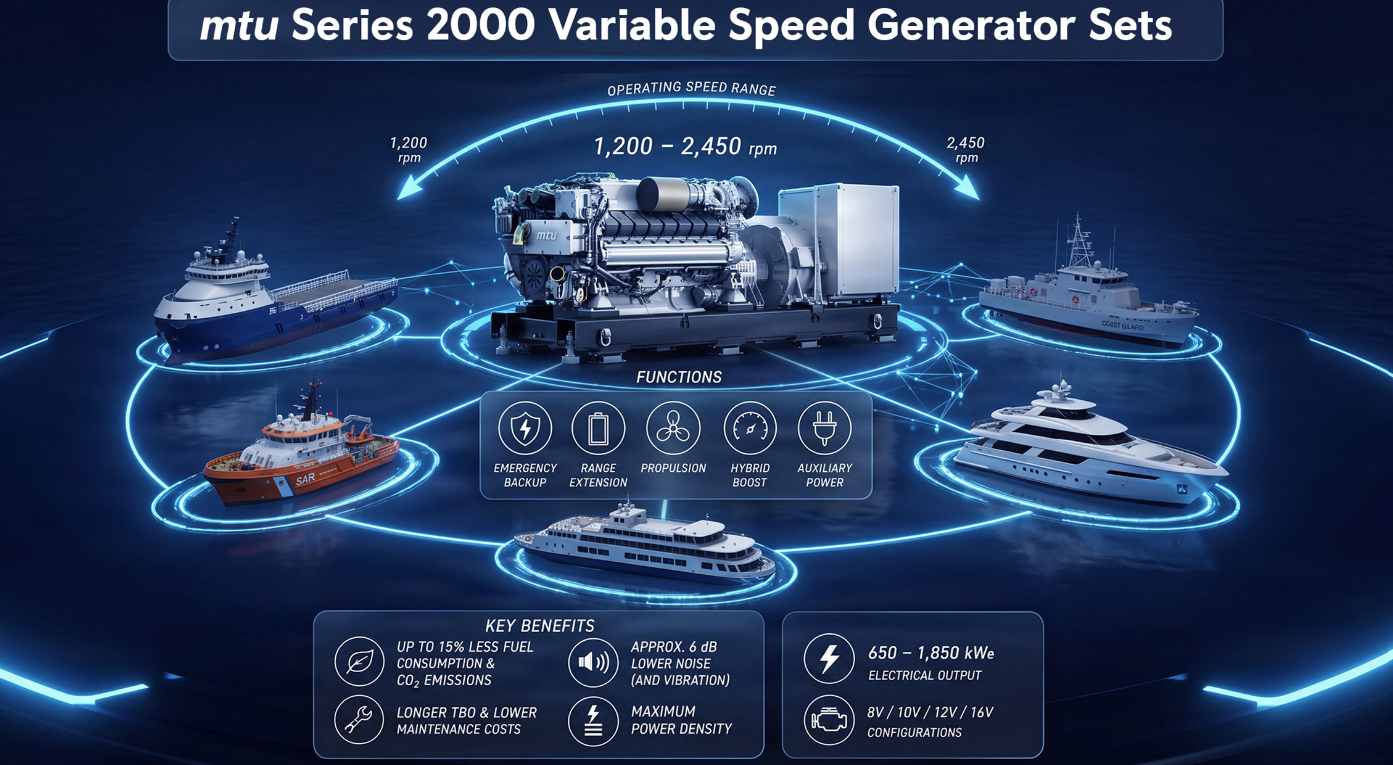
Cost-effective, compact, and powerful — variable-speed mtu generator sets with multiple benefits for ship operators
Longer intervals between overhauls (TBO) and lower maintenance costs ensure high cost-effectiveness over the entire life cycle. Their compact design and high-power density make the generator sets particularly attractive for vessels with limited space and weight constraints, such as passenger ferries, crew boats, offshore supply vessels, yachts, and patrol boats.
“With our new offering, we provide an industry-wide advantage by offering variable-speed generators that cover a very wide power range — we offer 8V, 10V, 12V, and 16V models. This allows us to offer our customers a generator for every project that is optimally sized and highly efficient,” explained Dr. Lukas Köhler, Senior Vice President of Global Marine & Mining at Rolls-Royce Power Systems.
The new standardized, variable-speed generator set, with an operating speed range of approximately 1,200 to 2,450 rpm depending on the engine type, and an electrical output of 650 to 1,850 kWe, offers optimal adaptation to different load profiles — also making it ideal for modern, battery-powered marine applications and as a range extender.
The new product is based on Rolls-Royce’s decades of experience with diesel-electric propulsion systems. Numerous workboats already have variable-speed mtu gensets based on the Series 4000 on board, and many yachts benefit from diesel-electric propulsion systems based on the Series 2000.
Reliable and efficient gensets as the backbone of maritime electrification
The role of gensets on ships has evolved and is no longer limited to propulsion and auxiliary operations. On battery-powered ships, they serve as an emergency power source for propulsion, and on hybrid ships, they extend the range and act as boosters.
“Even ships with battery- or electric-powered main propulsion systems benefit from the reliability and efficiency of mtu’s variable-speed gensets. In combination with our modern mtu internal combustion engines, which can run on sustainable fuels, they support the trend toward ship electrification and the maritime energy transition,” said Lukas Köhler.
For more information visit: mtu-solutions.com
News Categories
- » NEWS HOME
- » Automation & Robotics
- » Industry 4.0
- » Material Handling
- » Sensors
- » Quality & Testing
- » Machine Vision
- » Laser & Optics
- » Metalworking
- » Motion Control & Drives
- » Hydraulics & Pneumatics
- » Process Industry
- » Renewable Energy
- » Agriculture
- » Home & Office Furniture
- » Additive Manufacturing
- » Environmental Tech
Related Expos



Tags
 |
 |
 |
 |
 |
 |
 |
 |
 |
 |
 |
 |
 |
 |
 |
 |